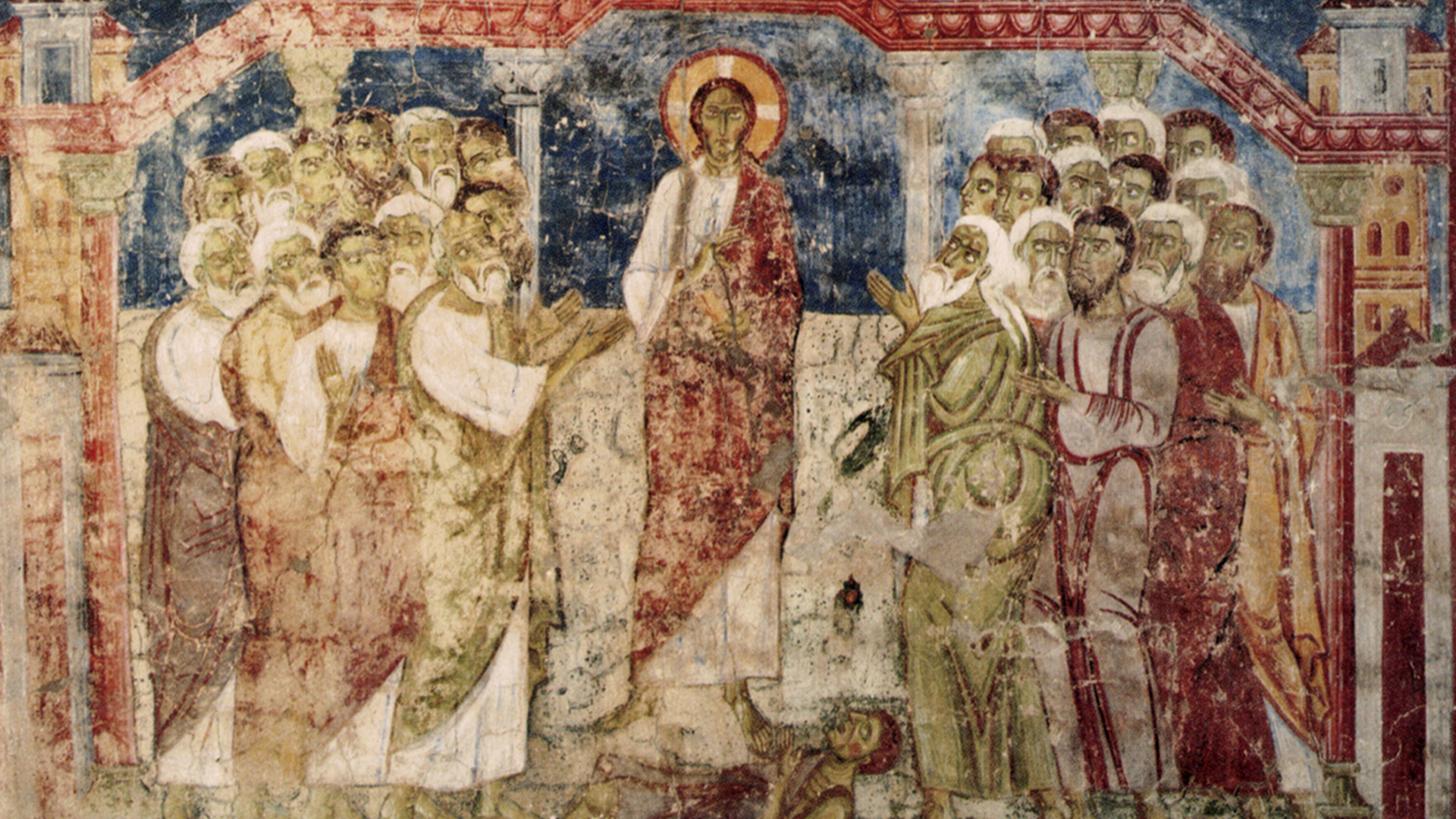
But Jesus rebuked him, saying, “Be quiet, and come out of him!” And when the demon had thrown him in their midst, it came out of him and did not hurt him. Then they were all amazed and spoke among themselves, saying, “What a word this is! For with authority and power He commands the unclean spirits, and they come out.” And the report about Him went out into every place in the surrounding region. (Luke 4:35–37; NKJV)
After Jesus was rejected in His hometown of Nazareth, He went down to Capernaum (Luke 4:31). Nazareth was in the southern rocky hills of “upper Galilee” near the Jezreel Valley.1 Capernaum was roughly twenty miles to the northeast in “lower Galilee,” on the western coast of the Sea of Galilee.2 Jesus going “down to Capernaum” was the local way of describing travel through the terrain of the region from the hills of upper Galilee to the lowland of lower Galilee.
Luke recounts Jesus’ teaching in Nazareth and Capernaum with similarities that highlight the differences between the accounts. In both accounts, we read about Jesus teaching in the synagogue on a Sabbath. In both accounts, we read that the people initially responded with curiosity and wonder (vv. 22, 32). But while Nazareth questioned Jesus’ authority (v. 22), Capernaum acknowledged it (v. 32). Whereas in Nazareth the crowds rose up against Jesus (vv. 28–29), in Capernaum they came to Him and He healed them (vv. 40–42).
While Jesus was teaching in the synagogue at Capernaum, a demon-possessed man shouted out. Jesus rebuked and cast out the demon and the onlookers “were all amazed [thambos]” at the “authority [exousia] and power [dunamis]” Jesus has over unclean spirits. Reports of exorcisms in the ancient world are rare and “do not closely resemble the exorcisms of Jesus.”3 This miracle just witnessed in the synagogue thus offered further confirmation of Jesus’ divine anointing by the Holy Spirit as the Son of God (vv. 3:22; 4:14).
Rarely were people amazed (thambos) in the New Testament. Often people marveled (thaumazo) and sometimes they were astonished (ekplesso). But only Luke uses the word ‘amazed,’ and only three times: here, in the fishermen’s response to their miraculous catch (Luke 5:9), and in the people’s response to Peter’s healing the lame man at the Temple gate (Acts 3:10).
The authority (exousia) of Jesus was a primary issue of conflict during His earthly ministry—especially His authority to forgive sins (Luke 5:24) and to cleanse and teach in the Temple (Luke 19:45–20:8). The religious leaders in ancient Israel rejected Jesus’ authority because He was not one of them and His teaching was not in line with their own (for example, see Jesus’ teaching and healing on the Sabbath, Luke 6:1–11).
One way we can perceive leaders who are not following Jesus is by their teaching. Many leaders today invoke the name or teachings of Jesus to support their own agendas. But these same leaders often only use the “nice” parts of Jesus’ teachings. Any leader that doesn’t uphold the entirety of Jesus’ teaching—both the “nice” parts and those less comfortable, more challenging parts—is not following Jesus or teaching others to do so.
The power (dunamis) of Jesus was another primary issue of conflict during His earthly ministry. The religious leaders of Jesus’ day could not deny the many miracles Jesus did. But they could and did challenge the source of His power, claiming it came from “Beelzebub, the ruler of the demons” (Luke 11:15). Jesus roundly refuted their claim, explaining that His power was a demonstration of the kingdom of God coming near to them (v. 20).
In contrast, many modern critics and skeptics challenge Jesus’ power by denying its historicity. Commonly, they argue that Jesus was a magician and charlatan, using sleight of hand to trick people. After all, such accounts are not empirically reproducible—so the argument goes.
But this argument fails for two reasons. First, history is made up of innumerable unique events, not reproducible experiments. Therefore, a proper investigation of history cannot be based primarily on empiricism. Rather, it requires thorough study of primary accounts and artifacts.
Second, miracles are, by definition, rare and refer to the momentary suspension of otherwise natural processes. To require empirical reproduction of such occurrences is to deny the very definition of such events.
Rejecting the authority and power of Jesus for these reasons is, therefore, neither empirically nor logically valid. Such rejection merely exposes underlying assumptions of deeply held worldviews, especially characterized by an inherent anti-supernatural bias.
When the eyewitnesses heard and saw the authority and power of Jesus in the synagogue, they were amazed. Of course, such a response does not indicate salvation. Signs and wonders confirm the identity of Jesus, but only hearts open and willing to receive such evidences will trust in Him. Hearts committed to rejecting Jesus will find many other explanations for the impact of His teachings and manner of His miracles. Only those open to the possibility of Jesus as the Son of God can receive the faith necessary to save us from our sins and receive eternal life.
Christian—do you still have a sense of amazement about Jesus? It can be easy to lose in the fast pace and frequent pains of life. You have believed in Jesus Christ. Let your heart be captivated by amazement with Jesus once more!
Notes
- Thomas V. Brisco, Holman Bible Atlas (Nashville, TN: Broad,an & Holman, 1998), 220. Logos Bible Software.
- Ibid., 221.
- James R. Edwards, The Gospel According to Luke, Pillar New Testament Commentary (Grand Rapids, MI: Eerdmans, 2015), 144. Logos Bible Software.
Discover more from Tim Northup
Subscribe to get the latest posts sent to your email.
 Tim Northup
