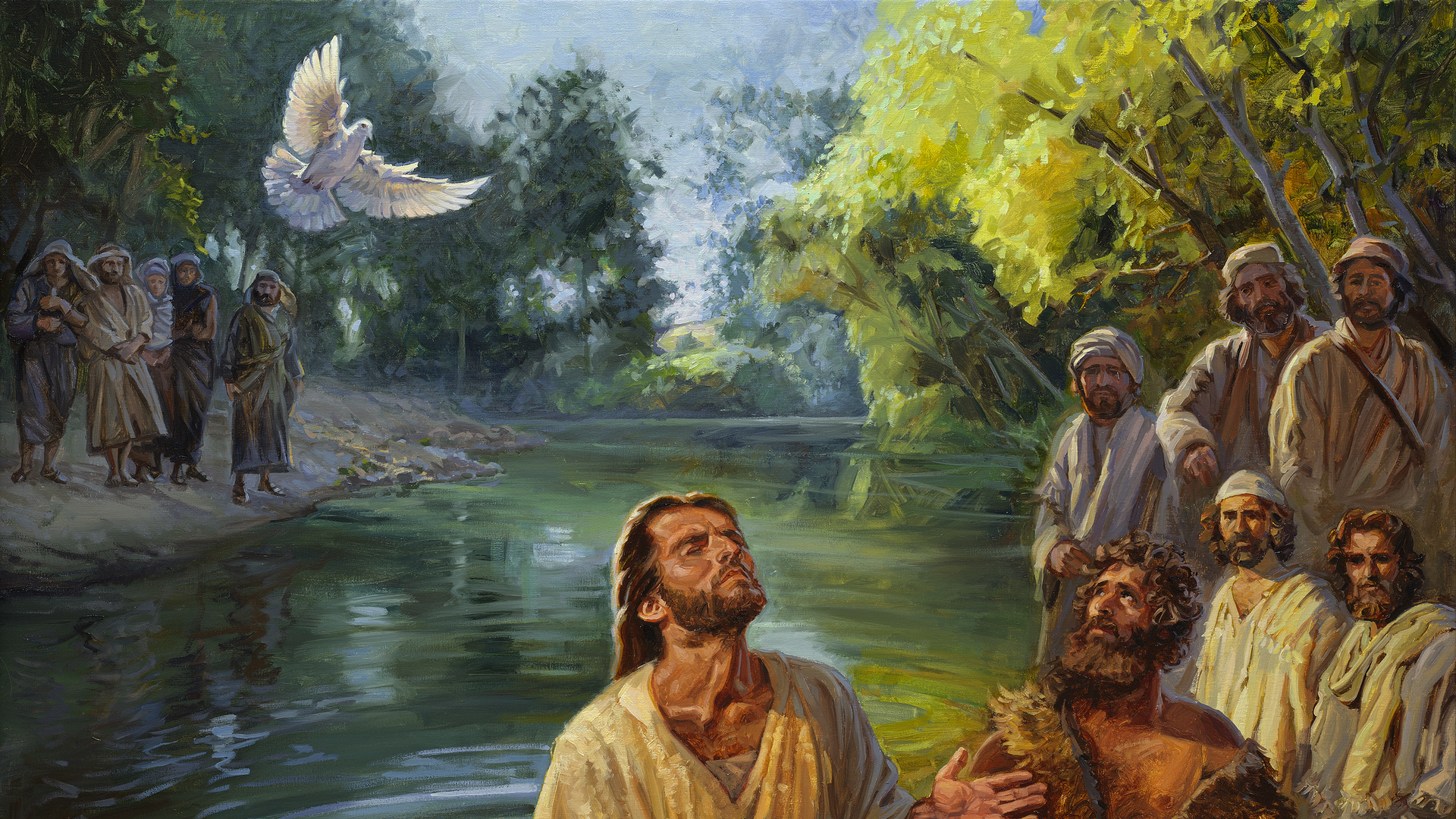
When He had been baptized, Jesus came up immediately from the water; and behold, the heavens were opened to Him, and He saw the Spirit of God descending like a dove and alighting upon Him. And suddenly a voice came from heaven, saying, “This is My beloved Son, in whom I am well pleased.” (Matthew 3:16–17; NKJV)
The Trinity is an established Christian doctrine. But a lot of Christians have a hard time making sense of it. The doctrine of the Trinity is often criticized, as well, for not being historical and for teaching the worship of multiple gods. What is the Trinity? Is it a historical Christian doctrine? Does it teach worship of multiple gods? Let’s dive in.
The Trinity is one of the core doctrines of historical Christianity. The idea is that God exists in a threefold-unity: one God manifested in three Persons. The doctrine makes three key statements: “1. there is but one God; 2. the Father, the Son and the Spirit is each fully and eternally God; 3. the Father, the Son, and the Spirit is each a distinct person.”1
Three words can be used to describe the Trinity: coequal, coeternal, and consubstantial. The Father, Son, and Holy Spirit are coequal: they are equal in authority and power. They always operate in perfect unity. None is higher or lower in degree, nature, or rank than the others.
The Father, Son, and Holy Spirit are also coeternal: all three exist from eternity past. Relationally, the Son is eternally begotten of the Father. And the Holy Spirit eternally proceeds from the Father and Son. But as to existence, all are eternal and none existed before the others.
The Father, Son, and Holy Spirit are consubstantial: they are all the same God. Jesus and the Holy Spirit are the same nature (substance) as the Father. The Father is God; the Son is God; the Holy Spirit is God. They are not three gods. There is only one all-mighty, eternal, triune God.
God exists in three persons, not just one: the Son is not the same person as the Father. The Holy Spirit is not the same person as the Father or the Son. Each person has unique roles and responsibilities in how God reveals Himself and operates the natural and spiritual realms.2
In the early church, there were two extreme views about God. The first, called Monarchianism or modalism, stresses the oneness of God to such a degree that it denies the distinctiveness of the Son and the Holy Spirit. In this view, the Father operates in different ‘modes,’ appearing as different identities in different situations. In this view, the Son and the Spirit are merely different expressions of the Father. This view is taught today in different ways by groups such as Unitarianism and Oneness Christology.3
The second view, called Christian polytheism or tritheism, stresses the threefold nature of God to such a degree that it denies the oneness of the Godhead. In this view, the Father, Son, and Holy Spirit are not only three distinct persons, but three entirely different beings. This view denies that Jesus and the Holy Spirit are coequal, coeternal, and consubstantial with the Father. This view is taught today in different ways by groups such as the Jehovah’s Witnesses, and Mormons.4
The early church rejected both views. In response to modalism and tritheism, the early church developed and affirmed the Nicene Creed (381 A.D.):
We believe in one God—And in one Lord Jesus Christ, the Son of God, begotten of the Father, light of light, very God of very God, begotten not made, being of one substance with the Father—And we believe in the Holy Ghost, who is the Lord and giver of life, who proceedeth from the Father, who with the Father and Son, is worshipped and glorified, who spake by the prophets.5
So, is the doctrine of the Trinity historical? Yes, the Trinity is the historical Christian doctrine describing the relationship between the Father, Son, and Holy Spirit. Does the Trinity teach worship of multiple gods? No, it does not teach worship of multiple gods—it upholds the oneness of the Godhead. The doctrine of the Trinity captures the oneness of God as well as the distinctiveness of the Father, Son, and Holy Spirit—both the unity and the uniqueness of the persons as God has revealed Himself to be.
Notes
- Max Turner and Graham McFarlane, “Trinity,” in New Bible Dictionary, ed. D. R. W. Wood et al., (Downers Grove, IL: InterVarsity Press, 1996), 1209. Logos Bible Software. Italics theirs.
- For a thorough treatment on the Trinity, see Guy P. Duffield and Nathaniel M. Van Cleave, Foundations of Pentecostal Theology (Los Angeles, CA: L.I.F.E. Bible College, 1983), 86-115.
- “Does One Equal Three?” Biblical Unitarian, accessed August 4, 2023, https://www.biblicalunitarian.com/articles/does-one-equal-three. “The True Humanity of Christ,” United Pentecostal Church International, accessed August 4, 2023, https://upci.org/wp-content/uploads/2022/09/The_True_Humanity_of_Jesus_Christ.pdf.
- “Is Jesus Almighty God?” Jehovah’s Witnesses, accessed March 3, 2022, https://www.jw.org/en/bible-teachings/questions/is-jesus-almighty/. “What Is the Holy Spirit?” Jehovah’s Witnesses, accessed March 3, 2022, https://www.jw.org/en/bible-teachings/questions/what-is-the-holy-spirit/. “Latter-day Saints 101: What Church Members Believe” The Church of Jesus Christ of Latter-Day Saints, accessed March 3, 2022, https://newsroom.churchofjesuschrist.org/article/latter-day-saints-101.
- Duffield and Van Cleave, 87. Logos Bible Software.
Discover more from Tim Northup
Subscribe to get the latest posts sent to your email.
 Tim Northup