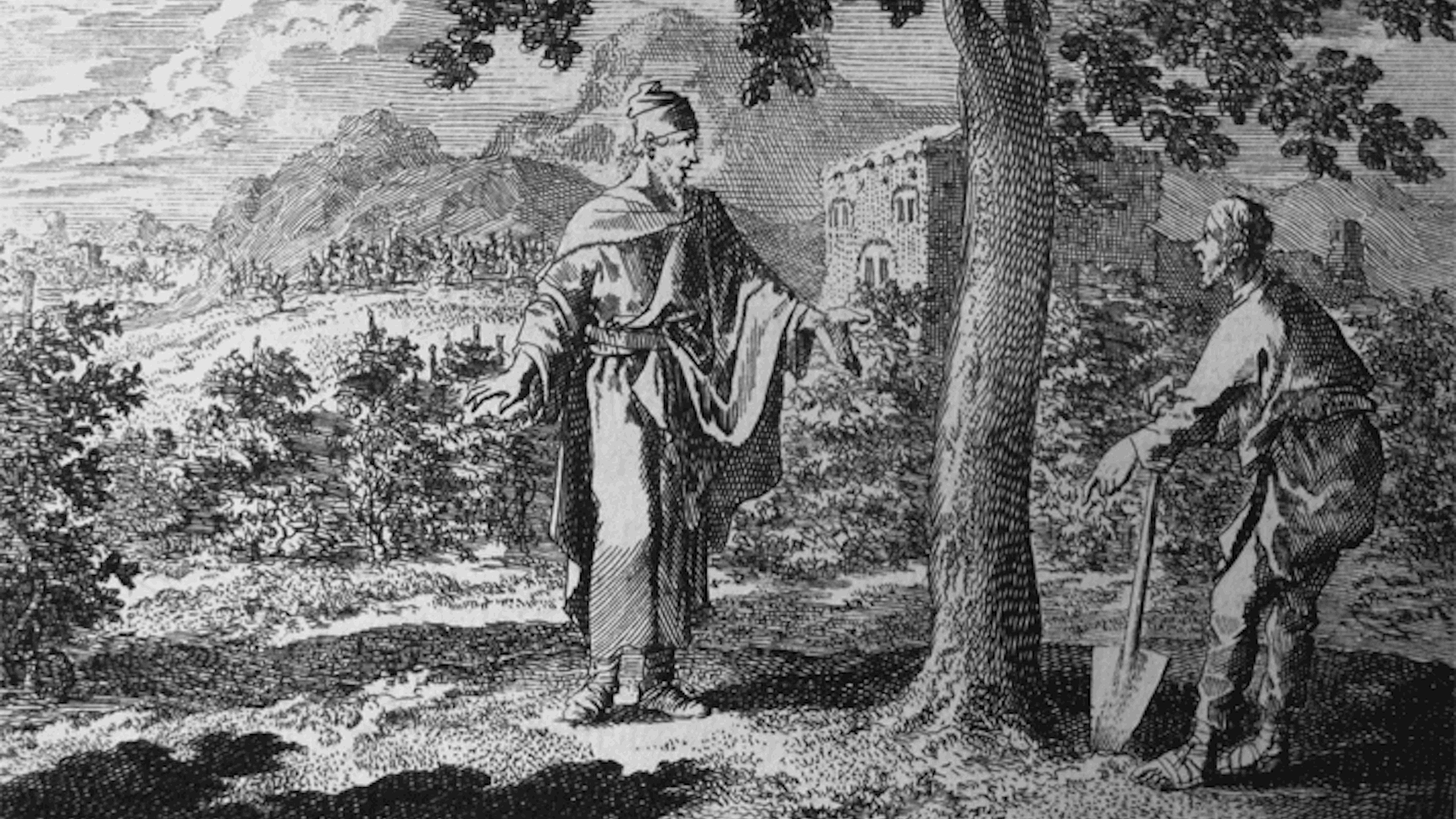
He also spoke this parable: “A certain man had a fig tree planted in his vineyard, and he came seeking fruit on it and found none. Then he said to the keeper of his vineyard, ‘Look, for three years I have come seeking fruit on this fig tree and find none. Cut it down; why does it use up the ground?’ But he answered and said to him, ‘Sir, let it alone this year also, until I dig around it and fertilize it. And if it bears fruit, well. But if not, after that you can cut it down.’ ” (Luke 13:6–9; NKJV)
The Parable of the Fig Tree is an important message about Israel, repentance, and receiving Jesus. But before we can understand what it means, we need to look at its context.
The middle chapters of Luke focus on following Jesus. We can outline the flow of Luke’s message in Chapters 9 through 14 along these lines:
- Invitation to the Kingdom (ch. 9–10)
Jesus as the Christ and sharing the Kingdom of God with Israel. - Character of the King (ch. 11–12)
The authority of Jesus and seeking the Kingdom of God. - Entrance to the Kingdom (ch. 13–14)
The need for repentance and the exclusivity of the Kingdom of God.
The Parable of the Fig Tree (13:6–9) is sandwiched between Jesus’ teaching on the necessity of repentance (13:1–5) and the hypocrisy of the Jewish leaders (13:10–17). Widening our view, there is evidence of an X-shaped (chiastic) structure that emerges.1 I will outline it here like this:
A. Jerusalem’s Division Over Jesus (12:39–53)
     B. Discerning the Offer of the Kingdom (12:54–56)
          C. Peace with Enemies before the Judgment (12:57–59)
               D. Israel’s Need for Repentance (13:1–5)
                    E. Parable of the Fig Tree (13:6–9)
               D’. Hypocrisy over Sabbath Healing (13:10–17)
          C’. Parables of the Mustard Seed and Leaven (13:18–21)
     B’. Discerning the Way into the Kingdom (13:22–30)
A.’ Jerusalem’s Rejection of Jesus (13:31–35)
This style of narrative is a classic Hebrew style that uses parallel ideas and points, like an arrow, to the middle idea—the Parable of the Fig Tree. But before proceeding further, we need to gather a bit more information about the fig tree. We need to look at its importance to ancient Israelite culture and also in the Old Testament.
The fig tree was an important part of life in ancient Israel. As Ryken et al. summarize,
The fig tree was one of the most important domesticated plants in the biblical era and was widely cultivated throughout [Israel]. It grows best in moderately dry areas that have little or no rain during the period of fruit maturation. The tree was cultivated for its delicious fruit and appreciated for its dark green and deeply lobed leaves, which produced a welcome shade (Mic 4:4; Zech 3:10; Jn 1:48).2
The Fig Tree is also an interesting Old Testament symbol. It first appears when Adam and Eve attempt to cover themselves after disobeying God (Gen 3:7). Then, in the Books of Moses the fig tree becomes a symbol of the Promised Land (Num 13:23; 20:5; Deut 8:8). God also uses the fruit of the fig tree to bring Hezekiah relief in his life-threatening illness, followed by the promise and sign that he would make a full recovery (2 Kgs 20:7; see vv. 1–11).
The fig tree is not a significant symbol in the Books of Wisdom. It mentioned in Psalm 105:33 regarding God’s plagues on Egypt, in Proverbs 27:18 about servanthood, and in Song of Solomon 2:13 about the budding of desire between the Lover and his Beloved.
It is more prominent in the Prophets. Two passages in Jeremiah use fig tree in the context judgment. First, Jeremiah 8:4–17 speaks of God’s judgment on Israel for her disobedience, including idol worship in the high places. Second, Jeremiah 24 speaks of God’s promise to protect the Israelite exiles taken captive by Nebuchadnezzar king of Babylon, while allowing those in the Southern Kingdom to suffer reproach of invasion and being driven from the Land.
Joel depicts the Father as the owner of a fig tree entrusted to Israel’s care, which has withered due to foreign invaders (Joel 1:1–12), but which God promises refresh at a future time (Joel 2:18–27) following Israel’s corporate, repentant response to the Day of the Lord (Joel 2:1–17). Similar future prophecies are found in Micah 4:4; Zechariah 3:6–10.
We have good reason, then, to see the fig tree as a symbol of promise, especially relating to Israel. A mature, fruitful fig tree symbolizes favor and prosperity. A fig tree with bad fruit symbolizes disobedience and judgment. A fruitless fig tree in season, as depicted, is a symbol of disobedience and impending judgment.
We can now put the pieces together and interpret the parable. The structure tells us that, as Jesus is approaching Jerusalem (Luke 13:22), the time has come (Luke 12:52) for Israel as a whole to make a decision about Him (Luke 13:1–5). So far, Israel as a whole has not been willing to receive Jesus and faces impending judgment (Luke 13:7). But there is still a short time for Israel to receive Jesus (13:8). However, if she does not, she will receive judgment (13:9).
James Edwards gives a helpful summary,
Through the parable of the Fig Tree Luke prepares readers for the fate of the Jewish nation. A fruitless tree is not promising; it would probably be wiser, and certainly simpler, to cut it down. But these are not equal and indifferent options in the mind of the owner. … The Greek eis to mellon literally means “for the future,” implying hope for a better state of affairs: “Well and good” (so NRSV) or “so much the better!” A cloud of futility has hung over the parable until this point, and one expects the tree to be cut down. Here, finally, there is a ray of hope. The gardener wants the tree to live and bear fruit, and he makes the more costly choice to allow for the possibility. He digs down and fertilizes the root of the tree—where repentance must take place.3
Would Israel as a whole receive Jesus, at this time, on His terms, as their Messiah (Luke 13:34)? The answer was no, not as a whole, not at that time (Luke 13:35). However, Israel’s judgment is not forever, but only temporary (Rom ch. 11, especially vv. 23–27). There is hope for the future. Israel as a whole will one day recognize Jesus as her Messiah, at “the time comes when [Israel says], “Blessed is He who comes in the name of the LORD!” (13:35).
What does this mean for us today? First, it means God has not abandoned Israel. She still has a future in His plans for the course of history and eternity. Second, it reminds us that repentance is a necessary part of receiving Jesus (I hope to address what that means in a future post). Third, it gives us confident hope that God is true to His promises, that He does not abandon us, He is working all things for our good, He is moving all things toward a glorious eternity with Him.
Notes
- James R. Edwards, The Gospel according to Luke, ed. Donald A. Carson, The Pillar New Testament Commentary (Grand Rapids, MI: Eerdmans, 2015), 390. Logos Bible Software.
- Leland Ryken et al., Dictionary of Biblical Imagery (Downers Grove, IL: InterVarsity, 2000), 283. Logos Bible Software.
- Edwards, The Gospel according to Luke, 393.
Discover more from Tim Northup
Subscribe to get the latest posts sent to your email.
 Tim Northup

Pingback: The Narrow Gate | Tim Northup