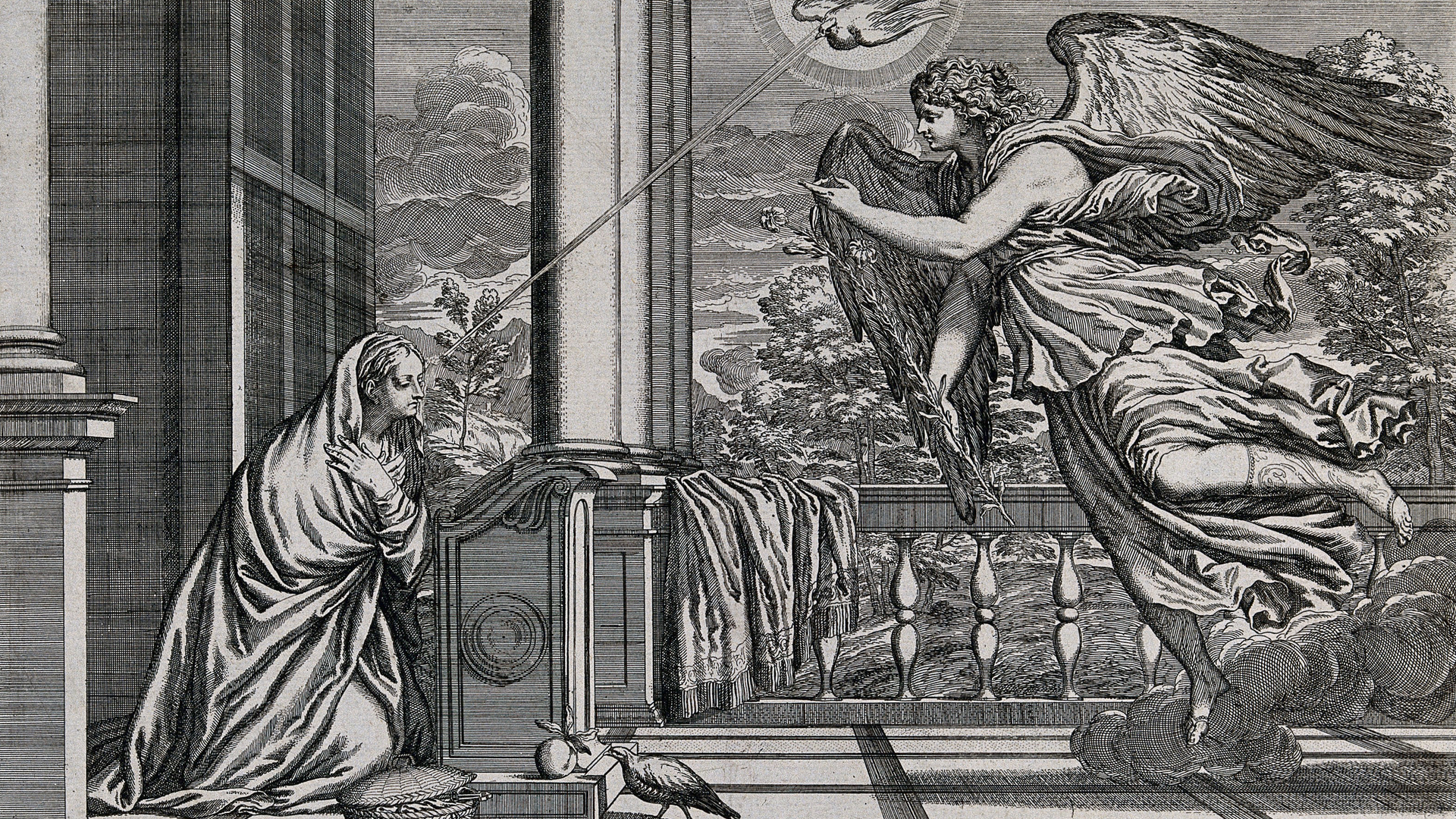
Then Mary said to the angel, “How can this be, since I do not know a man?” And the angel answered and said to her, “The Holy Spirit will come upon you, and the power of the Highest will overshadow you; therefore, also, that Holy One who is to be born will be called the Son of God. … Then Mary said, “Behold the maidservant of the Lord! Let it be to me according to your word.” And the angel departed from her. (Luke 1:34–35, 38; NKJV)
One of the interesting things we find reading through books of the Bible is seeing how different passages relate to each other. For example, God often places narratives side-by-side to highlight key ideas (called parallelism). Luke wrote the narratives of Zacharias and Mary in this way, highlighting the idea of trusting in God and His promises.
Luke arranges the announcements to Zacharias and Mary in similar ways. Both narratives begin by briefly describing their circumstances. In both, an angel brings the announcement, saying, “do not be afraid,” followed by a message about a promised child. Both Zacharias and Mary respond with a question, “how …?” And both scenes close with a woman of faith blessing God.
The similarities in the narratives make the differences more apparent. Zacharias was an older man, married, a priest, serving in the Temple. His life revolved around His Levitical service to God. Mary was a young virgin woman,1 pledged to marry a carpenter named Joseph. Her life would soon revolve around being the domestic manager and primary caregiver for her family.2
There are two more important differences. First, when the angel comes to Zacharias, the angel tells him, “your prayer is heard.” Zacharias and Elizabeth had been praying about not having children, so God’s promise was an answer to their prayers. In contrast, the angel tells Mary, “you have found favor with God.” God’s promise of a child to Mary was surely unexpected.
Second, Zacharias receives rebuke for his “how …?” question but Mary does not. Why is that? Zacharias and Elizabeth were praying for a child, but when the angel came with God’s answer, Zacharias doubted (v. 20). In contrast, the promise Mary received was quite unexpected, but she received it with faith and humility, blessing the Lord (v. 38).
Why did God choose Zacharias and Elizabeth to be John’s parents? Why did God choose Mary as mother to Jesus? The Bible doesn’t tell us. Truly God’s thoughts and ways are higher than ours (Isa 55:8–9). And there are many things He has not revealed to us (Deut 29:29). We must be careful not to think they had somehow earned such privilege. And yet, God knew His promises about the Forerunner and the Messiah would be secure in their households.
John and Jesus are central to God’s prophetic timeline. We can be sure that God knew that John and Jesus would be cared for and raised in such a way that His promises about their lives and ministries would come to pass. We can also be sure that God, both directly and indirectly through ministering spirits (Heb 1:14), was working in their lives.
But there was no uncertainty on God’s part that no power, human or otherwise, would derail His plans for the lives and ministries of John and Jesus. Here, we see the intersection of God’s sovereignty, foreknowledge, omnipotence (all-powerfulness), and immanence (nearness to us) working together in the hearts and households of His servants who were surrendered to His will.
God’s promises to both Zacharias and Mary came to pass. Although Zacharias initially doubted while Mary believed, neither promise was conditioned the recipient’s faith-response. When God makes a promise, He makes sure it comes to pass. The question is not if or when God will make good on His promises, but how we will respond.
Mary, a young adolescent betrothed to a carpenter, is a beautiful example of the positive response God desires of us—voluntary surrender to His will. Zacharias, an elder priest serving in the Temple, reminds us that God’s promises are sure, even in our moments of doubt. Both show us how intimately God knows our hearts and how He invites us to live by trusting in Him.
Our encouragement today, then, is to be reminded of the promises God makes to us. To recall those sure promises of Scripture. To seek God again for those promises we think we have received from Him in prayer. To choose an attitude of humble surrender to Him. And to ask Him to strengthen our faith, trusting in God and His promises in every moment of our lives.
Notes
- Probably between 13–15 years old. See Robert H. Stein, Luke, New American Commentary 24, ed. David S. Dockery (Nashville, TN: Broadman & Holman, 1992), 82. Logos Bible Software.
- Moisés Silva, The Essential Companion to Life in Bible Times (Grand Rapids, MI: Zondervan, 2011), 15. Logos Bible Software.
Discover more from Tim Northup
Subscribe to get the latest posts sent to your email.
 Tim Northup
