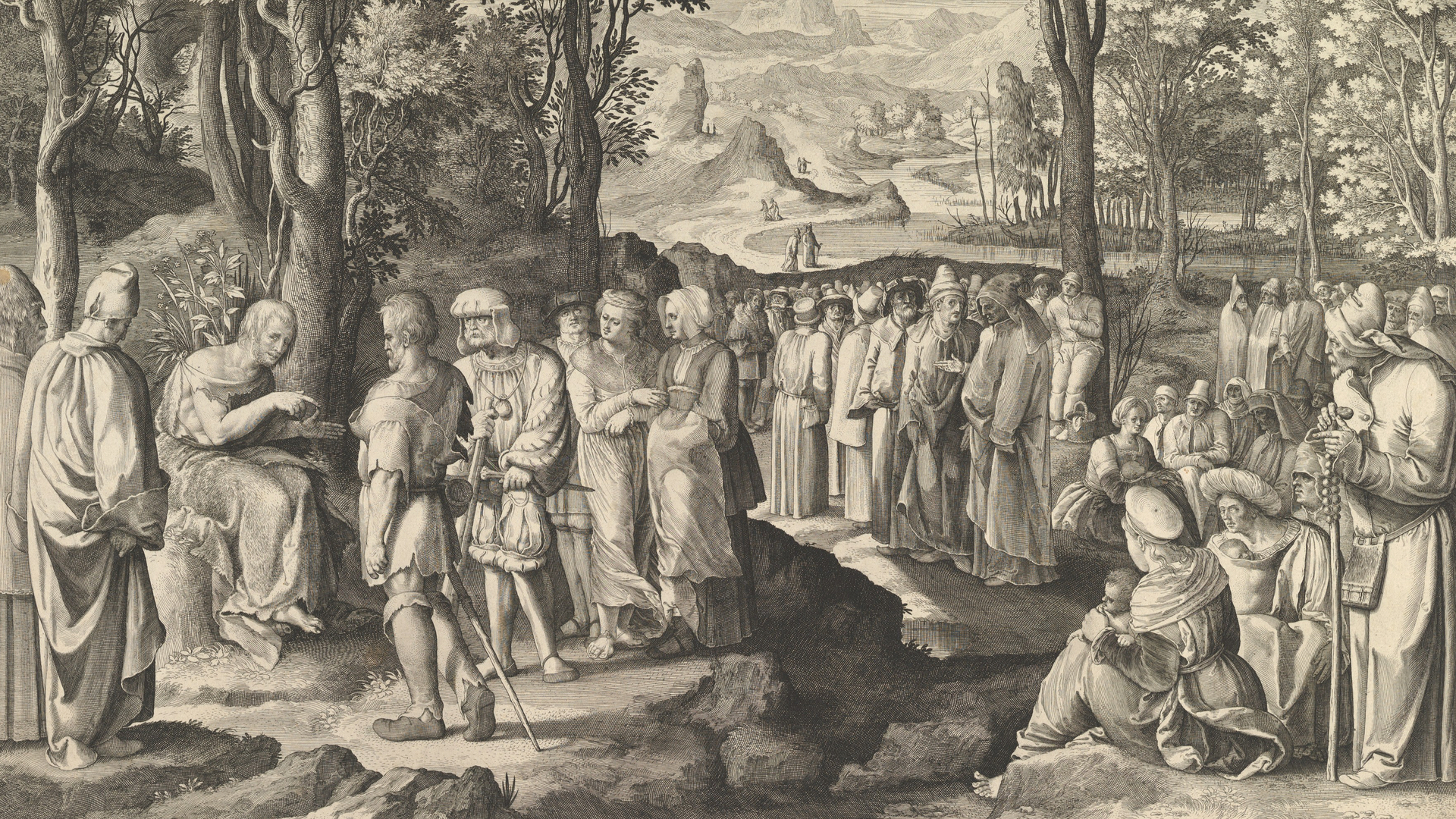
The word of God came to John the son of Zacharias in the wilderness. And he went into all the region around the Jordan, preaching a baptism of repentance for the remission of sins. (Luke 3:2–3; NKJV)
God fulfilled His promise to Zacharias. The Holy Spirit was upon John, and now “the Word of God came to John” in a mighty way. Luke does not tell us how the Word of God came upon him. But the message John preached reveals at least some of what this Word of God to John contained. It was the message of repentance for the remission of sins and the announcement that Israel’s Messiah was coming very soon (vv. 15–17).
The word ‘repentance’ in the New Testament has the basic meaning of changing your mind.1 In spiritual terms, it means “rejecting evil and turning to follow God.”2 Repentance, then, has two parts. First, it requires agreeing with God about the sin in your life. Second, it involves voluntarily renouncing that sin and turning toward God.
John connects repentance with “remission of sins.” The basic meaning of ‘remission’ is to let go or depart from.3 In the New Testament, it almost always has the spiritual sense of forgiveness.4 Repenting for the ‘remission’ of sins, then, refers to agreeing with God about your sin and turning toward Him to receive forgiveness.
We like the idea of forgiveness. It highlights the ‘nice’ qualities of God, especially His goodness and love toward us. It makes us feel warm and fuzzy. And we think about God’s forgiveness, it’s easy to overlook the specific, destructive ways sin shows up in our daily in our lives.
We have a lot harder time with repentance. Repentance is more concrete and personal. We have to face the sin deep within our hearts—the spiritual divide between us and God, and the great harm we’ve caused others and ourselves. We don’t measure up. We’ve fallen short. We’ve turned our backs on God. Which is precisely why salvation requires our turning back toward Him.
Culture says, “do what you want, as long as you’re not hurting anyone.” Repentance requires us to admit how frequently and deeply we do just that, whether or not its our intent.
“Jesus loves the sinner,” so we say. “Jesus meets us where we are.” Indeed, He does. His love for us is so committed to our good that He sent His own Son to die the death that we deserve so we can have the opportunity to live in eternally with Him.
But such committed love cannot exist eternally alongside the disruptive, destructive power called sin. Such love, by its very nature, insists on what is best for us. It must woo us to give up our sin and receive the transforming power of His Spirit within us. Such love must work to renew our hearts and conform us to the One Who saves us.
What does it look like to give up sin and receive the transforming power of God in our lives? First, it means recognizing the final results of sin. As John warned the crowds, “Who warned you to flee from the wrath to come? … even now the ax is laid to the root of the trees. Therefore every tree which does not bear good fruit is cut down and thrown into the fire,” (Luke 3:7, 9).
Hell is real. God made it for “the devil and his angels,” (Matt 25:41). But those who reject Jesus likewise reject eternity with Him. The only alternative is hell.
Second, such change involves yielding to God’s way of living. God is lovingly committed to caring for the poor, the sick, the oppressed, and the weary (Isa 41:17; 61:1–2; Matt 11:28). He instructs us to share and act in His concern (Micah 6:8; Jas 1:27).
On this point we must avoid two extremes. The first is apathy. As God changes our hearts, He moves us with compassion to respond on behalf of others. The second is coercion. God did not command us to take over the government and force compassion on others. God has called us to have loving influence that points others to Him. This is why today’s social justice movements are backwards and upside down.
Between these extremes, God woos us to yield to His love and share that love with others (Matt 5:14–16). This is how God is growing His Kingdom now. Not through coercion, compliance, and the government, but through compassion, evangelism, and the testimony of the church (John 3:5; Col 4:11; 2 Thess 1:5).
Jesus came to seek and save the lost (Luke 19:10). When we turn from sin toward God, He forgives our sins begins that saving work in us (Phil 1:6). We receive that salvation by trusting in Jesus—agreeing with Him about our sin and turning from it toward Him. We walk in that salvation by receiving the lifelong process of His renewing our hearts and making us more like Him (Phil 2:12–13; Titus 3:4–7).
Notes
- Tremper Longman III and Mark L. Strauss, eds., The Baker Expository Dictionary of Biblical Words (Grand Rapids, MI: Baker, 2023), 670. Logos Bible Software.
- Ibid.
- Christopher A. Beetham, ed., Concise New International Dictionary of New Testament Theology and Exegesis (Grand Rapids, MI: Zondervan Academic, 2021), 127. Logos Bible Software.
- Ibid.
Discover more from Tim Northup
Subscribe to get the latest posts sent to your email.
 Tim Northup

Pingback: You Are My Beloved Son | Tim Northup