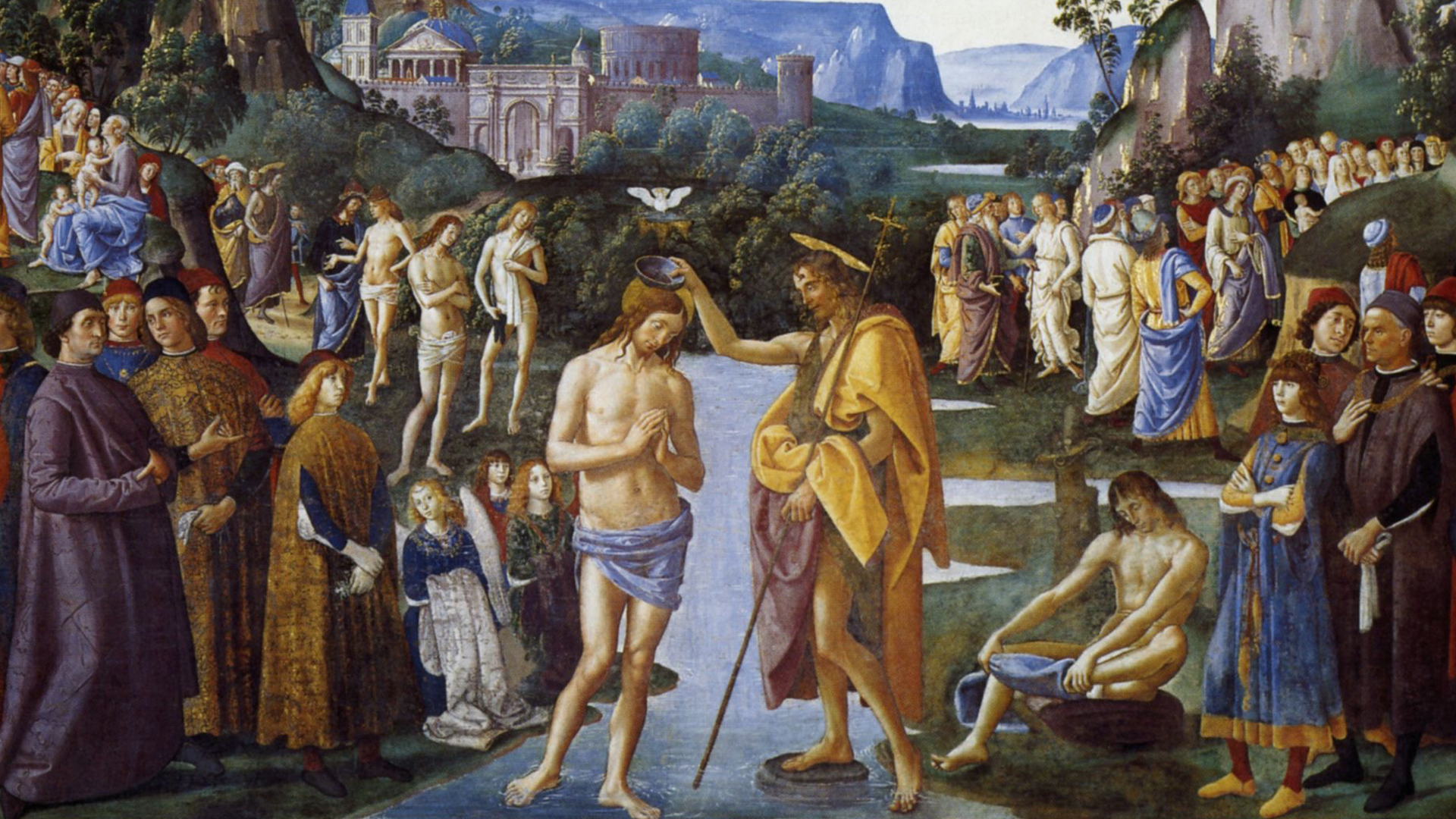
When all the people were baptized, it came to pass that Jesus also was baptized; and while He prayed, the heaven was opened. And the Holy Spirit descended in bodily form like a dove upon Him, and a voice came from heaven which said, “You are My beloved Son; in You I am well pleased.” (Luke 3:21–22; NKJV)
One of the many puzzling events during Jesus’ earthly ministry was His baptism by John in the Jordan. In my last post, we saw that John’s baptism signified the person’s renouncing their sin and turning toward God to receive God’s forgiveness of their sin. This raises the question, why did Jesus get baptized? Did He, too, need forgiveness for His sins?
When Jesus came to John to be baptized, John protested. John, knowing Jesus is the Messiah, knew that Jesus had no sin. Jesus did not need to repent or be forgiven of any sin in His life. In fact, it was Jesus Who would bring God’s forgiveness of sin into history by voluntarily dying in our place on the cross (John 1:29; 2 Cor 5:21).
Jesus answered John that His baptism was “fitting … to fulfill all righteousness” (Matt 3:15). The Greek word translated ‘fitting’ has the basic meaning of appropriate or suitable.1 It occurs two other times referring to Christ—in Hebrews 2:10, identifying Jesus with sinful humankind, and in Hebrews 7:26, distinguishing Jesus from the sinfulness of humankind.2 The idea is that Jesus choose to identify Himself with sinful humankind by being baptized by John. He did not have to—He freely chose to. Why? Because it was necessary for us to receive God’s forgiveness.
With that in mind, Jesus’ baptism highlights three important details:
- Jesus’ baptism identifies Jesus with Israel. God promised to Shepherd His people Israel (Ezek 34:11–12). Jesus saw Himself as that Shepherd (Matt 15:24). Also, God promised to “raise up” a Prophet like Moses in Israel (Deut 18:15–22). Jesus’ baptism and wilderness temptation marked the beginning of His prophetic earthly ministry (Heb 1:2), which primarily involved His preaching the Kingdom of God to Israel (Mark 1:12–15).
- Jesus’ baptism identifies Jesus with all humankind. God created us to live in eternal fellowship with Him (Gen 3:8; Rev 21:22–24). But Adam sinned and brought condemnation on all humankind (Rom 5:19). Our sin requires atonement, which Christ offered once-and-for-all (Heb 10:8–14). The Son became human to identify with human suffering and weakness (Heb 5:2–3). In doing this, He became our eternal High Priest and was able to “make propitiation for the sins of the people” (Heb 2:17–18).
- Jesus’ baptism identifies Jesus as the Son of God. This Messianic title found in Psalm 2:7. Psalm 2 says that God’s Anointed (v. 2) is the true King over all the earth (v. 8). He will one day rule and judge the nations (vv. 9, 12). And all peoples in all places and all times owe their allegiance and service to Him (vv. 11–12). The Son of God is God’s divinely appointed King over all Creation. Jesus is the Son of God, God’s anointed King.
In summary, the baptism of Jesus identifies Him as the Shepherd of Israel, the Sacrifice for sin, and the Son of God—our Prophet, Priest, and King. During His first coming, Jesus came to Israel preaching the good news of the Kingdom of God (Mark 1:14–15). He ended that ministry by giving Himself as the sacrificial offering to atone for our sins. Now, we wait expectantly, looking forward to His second coming, when He will return as King to establish His Kingdom on earth over all the nations (Rev 19:11–16).
Christian, take heart—by believing in Jesus, you have been born again as a member of Christ’s Kingdom (John 3:3–8)! Though we suffer now, our destiny is eternal rest with Jesus (2 Thess 1:4–7). Our promised inheritance is eternal life with Jesus Christ our Lord, a promise sealed and guaranteed by the Holy Spirit Who dwells within us (Eph 1:7–14).
Nothing can separate us from the great love of God which He has poured out on us, His children through Christ Jesus (Rom 8:37–39; 1 John 3:1). The troubles of this life are temporary and passing away. In your trials, sorrows, and pains, let these truths remind you of God’s promises and renew your hope in Him.
This is a faithful saying:
For if we died with Him, we shall also live with Him.
If we endure, we shall also reign with Him.
If we deny Him, He also will deny us.
If we are faithless, He remains faithful; He cannot deny Himself.
(2 Timothy 2:11–13)
Notes
- Colin Brown, “πρέπω,” in New International Dictionary of New Testament Theology, ed. Colin Brown et. al. (Grand Rapids, MI: Zondervan, 1986), 2:669. Logos Bible Software.
- Ibid.
Discover more from Tim Northup
Subscribe to get the latest posts sent to your email.
 Tim Northup

Pingback: Lord of the Sabbath | Tim Northup