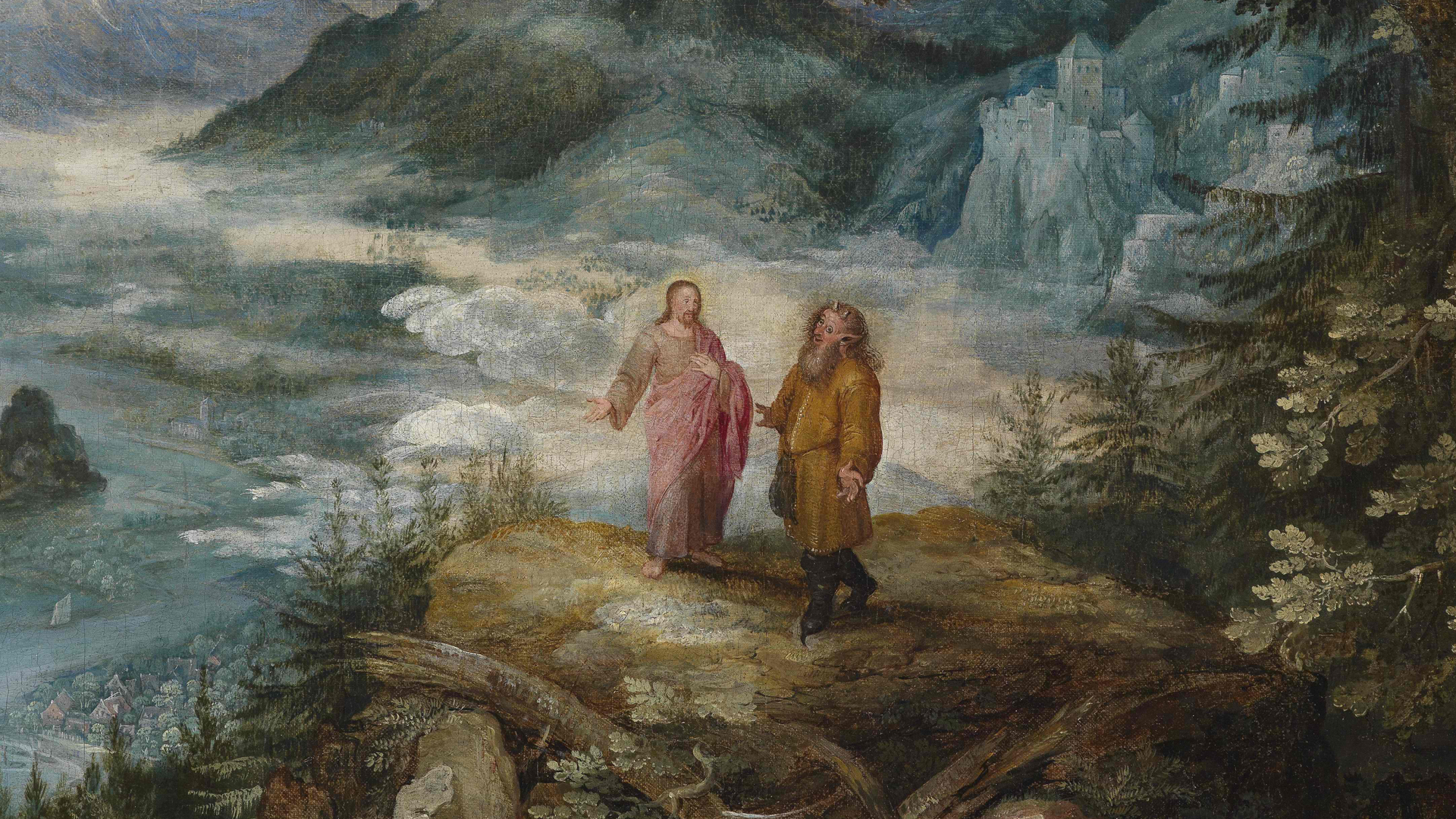
Then Jesus, being filled with the Holy Spirit, returned from the Jordan and was led by the Spirit into the wilderness, being tempted for forty days by the devil. And in those days He ate nothing, and afterward, when they had ended, He was hungry. (Luke 4:1–2; NKJV)
After Jesus’ baptism by John in the Jordan, the Holy Spirit led Jesus into the wilderness, where He endured temptation for 40 days.
Forty is an important number in the Bible. It rained 40 days and nights during the Flood (Gen 7:12). Israel’s twelve spies surveyed the Promised Land for 40 days (Num 13:25). Israel wandered in the desert for 40 years, representing a generation of people (Num 13:34). The Philistine oppression in Judges lasted 40 years (Judge 13:1). Saul, David, and Solomon each reigned over Israel 40 years (1 Kgs 2:11; 11:42; Acts 13:21). Forty represents a time of fullness and waiting, and sometimes judgment or testing, while God is graciously working.1
Luke says Jesus was ‘led’ (ago) by the Holy Spirit, in the sense of being continuously guided by the Spirit.2 Matthew says Jesus was “led up” (anago) by the Spirit, referring to the Spirit’s leading Jesus from the lower Jordan river valley, where He was baptized, to the higher wilderness country side, where He was tempted.3 Mark says the Spirit ‘drove’ (ekballo) Jesus into the wilderness, a stronger verb stressing the significance of Jesus’ wilderness temptation.4
These details are not contradictory, but complimentary. Together, they give us a much fuller picture of the details and theological significance of this event. God had just identified Jesus as His beloved Son. Now the Son, continuously empowered and guided by the Holy Spirit, began His victorious war campaign against the devil with a 40-day time of testing that confirmed again His identity as God’s Anointed.
Matthew and Luke record the same three temptations: turn stones to bread; worship the devil and receive the kingdoms of the world; and prove His Sonship by throwing Himself from the pinnacle of the Temple. The sequence of the second and third temptations differ in the two accounts, but this is not problematic. The sequence of each is not necessarily chronological, but theological, reflecting each writer’s theological focus.5
The temptation to turn the stones into bread is a divine reversal of Israel’s wilderness complaint. Repeatedly, after God delivered Israel from slavery in Egypt, Israel complained about food (Exodus 16:2; Num 11:4). It is also a divine reversal of Adam and Eve’s temptation to eat the forbidden fruit that was “good for food” (Gen 3:6). Jesus withstands this temptation, the “lust of the flesh” (1 John 2:16), appealing to God as our ultimate source of life (Gen 1:27; 2:7).
The temptation to worship Satan and receive the kingdoms of the world is a divine reversal of Israel’s idolatry. After God delivered Israel from Egypt and gave her the Ten Commandments, Israel broke the first and second commandments by making and worshiping the golden calf (Exod 20; 32). It is also a divine reversal of Adam and Eve’s temptation to eat the forbidden fruit that was “pleasant to the eyes” (Gen 3:6). Jesus withstands this temptation, the “lust of the eyes” (1 John 2:16), appealing to God as our King, who alone is worthy of our worship (Deut 20:12–22).
The temptation to prove His Sonship by throwing Himself from the pinnacle of the Temple is a divine reversal of Israel’s many wilderness failures to take God at His Word, such as instructions for collecting the bread from heaven on the sixth and seventh days (Exodus 16). It is also a divine reversal of Adam and Eve’s prideful rebellion against God’s instructions regarding the forbidden fruit (Gen 2:16–17; 3:4–7). Jesus withstands this temptation, the “pride of life” (1 John 2:16), freely choosing radical obedience to God alone (Phil 2:5–8).6
The temptation of Jesus is a “first-look” at the glorious power and will of Jesus our Lord. Where Adam failed, Jesus was faithful. where Israel failed, Jesus prevailed. Israel’s promised Prophet, Priest, and King had come from heaven into history. The promised Seed had come to take the battle to “that serpent of old, called the Devil and Satan” (Rev 12:9). At Calvary He claimed the victory, and one day He will return to establish His reign on earth (1 Cor 15:23–28, 55–57).
Christian, remember the radical obedience of Jesus our Lord. He voluntarily came and died for us because it was the Father’s will. It was necessary for our salvation, but it was freely chosen by the Son. He died for you because He loves you (1 John 3:16). Let your hope, joy, and peace be always found in Him.
Notes
- Philip P. Jenson, “אַרְבַּע,” in New International Dictionary of Old Testament Theology and Exegesis, ed. Willem A. VanGemeren (Grand Rapids, MI: Zondervan, 1997), 1:496. Logos Bible Software.
- Archibald T. Robertson, Word Pictures in the New Testament (Nashville, TN: Broadman, 1930), s.v. Luke 4:1. Logos Bible Software.
- John Nolland, The Gospel of Matthew: A Commentary on the Greek Text, New International Greek Text Commentary (Grand Rapids, MI: Eerdmans, 2005), 162. Logos Bible Software.
- James R. Edwards, The Gospel According to Mark, Pillar New Testament Commentary (Grand Rapids, MI: Eerdmans, 2002), 39. Logos Bible Software.
- Ibid., 126.
- David E. Garland, Luke, Zondervan Exegetical Commentary on the New Testament, ed. Clinton E. Arnold (Grand Rapids, MI: zondervan, 2011), 183. Logos Bible Software.
Discover more from Tim Northup
Subscribe to get the latest posts sent to your email.
 Tim Northup
