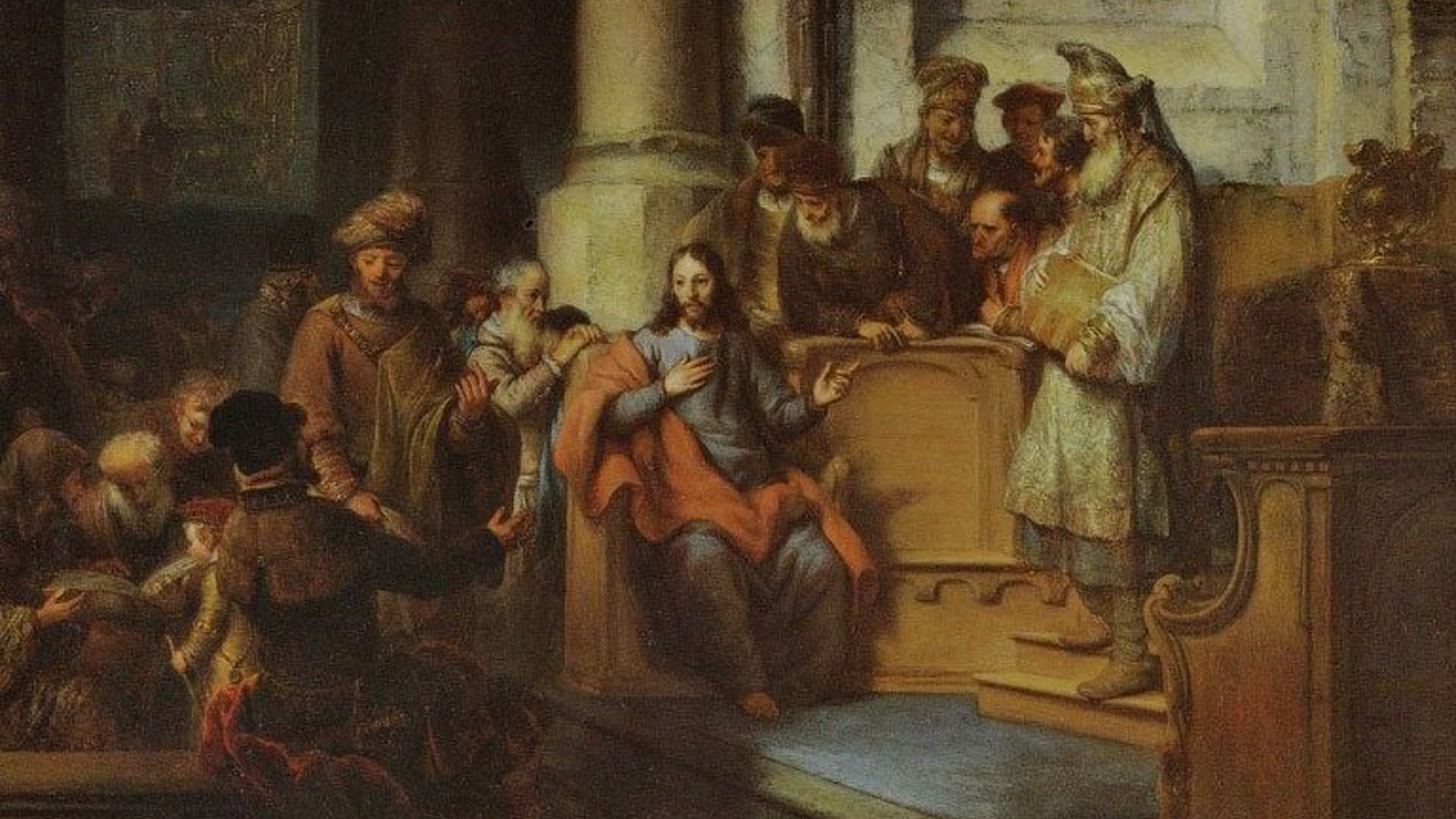
And He was handed the book of the prophet Isaiah. And when He had opened the book, He found the place where it was written: … Then He closed the book, and gave it back to the attendant and sat down. And the eyes of all who were in the synagogue were fixed on Him. And He began to say to them, “Today this Scripture is fulfilled in your hearing.” (Luke 4:17, 20–21; NKJV)
One of the major themes in the Gospel of Luke is fulfillment. Luke explains this focus in the introduction to his gospel account. In these verses, we see Luke emphasizing that theme in the beginning of Jesus’ earthly ministry.
After Jesus endured testing and temptation in the wilderness, He returned to Nazareth. When He was handed the scroll of Isaiah, He looked up and read a portion of Isaiah 61:1–2, then said, “Today this Scripture is fulfilled in your hearing,” (Luke 4:21, emphasis mine). Jesus was announcing that these Old Testament promises were being fulfilled in His earthly ministry.
The portions of Isaiah that Jesus does and does not quote are important. Here is the portion that Jesus quoted:
The Spirit of the Lord God is upon Me,
Because the Lord has anointed Me
To preach good tidings to the poor;
He has sent Me to heal the brokenhearted,
To proclaim liberty to the captives,
And the opening of the prison to those who are bound;
To proclaim the acceptable year of the Lord. (Isaiah 61:1–2a)
First, Jesus’ anointing by the Holy Spirit was demonstrated at His baptism and His wilderness testing. This Messianic anointing by the Holy Spirit (Ps. 2) would continue to be confirmed throughout His earthly ministry by His teaching with authority and powerful miracles (e.g., Luke 4:31, 36). Thus, the first two lines of Isaiah 61:1 were fulfilled.
Second, these verses reveal the primary focus of Jesus’ earthly ministry: Jesus was anointed to preach (euaggelizo, bring good news), to heal (iaomai, restore), to proclaim (kerusso, announce), and to set at liberty (aphesis, forgiveness).1 These are then summarized in the first line of verse 2 in terminology that refers to the Year of Jubilee (Lev. 25).2 Jesus’ primary activities during His first coming involved preaching the good news of forgiveness and freedom from sin and spiritual restoration and salvation unto eternal life. Since these activities stress the purpose of Jesus’s ministry, which had now begun, these promises were also fulfilled.
Third, notice that Jesus did not quote the remainder of verses 2 and 3, which says:
And the day of vengeance of our God;
To comfort all who mourn,
To console those who mourn in Zion,
To give them beauty for ashes,
The oil of joy for mourning,
The garment of praise for the spirit of heaviness;
That they may be called trees of righteousness,
The planting of the Lord, that He may be glorified. (Isaiah 61:2b–3)
Jesus did not say these promises were also being fulfilled at that time.3 Although the promises here in the rest of verses 2 and 3 will surely be fulfilled by Jesus, they were not the focus of Jesus’ ministry during His first coming. Further study suggests that the remainder of verses 2 and 3 will be fulfilled when Jesus returns (Isa 60:19–22, esp. 21; Rev 19:11–21).4
Jesus’ speaking in the synagogue in Luke 4 not only looks back to Old Testament promises of Isaiah that were being fulfilled in His earthly ministry. It also looks forward to Jesus’ rejection and crucifixion.
First, many people would reject Jesus because He did not fit one of the common views of the promised Messiah as primarily a national/political deliverer.5 We can see how this played out in Jesus’ ministry, for example, in Luke 13, where Israel’s collective rejection of Jesus becomes a primary issue in Luke’s gospel account.
Second, Jesus predicted the kind of mocking He would endure, mentioned both in Luke 22:63–65 and 23:35–36. This mocking included challenging Jesus to prophesy the identity of His attackers and to save Himself.
In summary, Jesus came in the anointing and power of the Holy Spirit bringing the good news of forgiveness of sins and eternal life. He then died on the cross to secure those promises and rose from the grave, proving His authority and power over life and death and showing that those promises have been secured.
Christian, be encouraged by remembering the sovereignty and suffering of Jesus Christ our Lord! Jesus came proclaiming forgiveness and freedom from sin and spiritual salvation unto eternal life. He determined beforehand that He would not save Himself from death. He laid down His life to secure those promises for us. Those of us who have trusted in Him, when we pass from this life to the next, will live with Him forevermore.
Notes
- Glosses from Christopher A. Beetham, ed., Concise New International Dictionary of New Testament Theology and Exegesis (Grand Rapids, MI: Zondervan Academic, 2021). Logos Bible Software.
- Geoffrey W. Grogan, “Isaiah,” in The Expositor’s Bible Commentary, Rev. ed., ed. Tremper Longman and David E. Garland (Grand Rapids, MI: Zondervan, 2008), 6:840. Logos Bible Software.
- Jesus said “Today this [houtos] Scripture.” He uses the demonstrative pronoun, houtos, singling out the portion of Scripture He had just read aloud as being fulfilled at that time. It would be an interpretive mistake to include the rest of verses 2 and 3 in that fulfillment. For more about the demonstrative pronoun, see Archibald T. Robertson, A Grammar of the Greek New Testament in the Light of Historical Research (New York: Hodder & Stoughton, 1914), 700. See also Daniel B. Wallace, Greek Grammar Beyond the Basics: An Exegetical Syntax of the New Testament (Grand Rapids, MI: Zondervan, 1996), 325.
- John A. Martin. “Isaiah,” in The Bible Knowledge Commentary: An Exposition of the Scriptures: Old Testament, ed. John F. Walvoord and Roy B. Zuck (Wheaton, IL: Victor, 1985), 1116. Logos Bible Software.
- Craig A. Evans, “Messianism,” in Dictionary of New Testament Background, ed. Craig A. Evans, Stanley E. Porter (Downers Grove, IL: InterVarsity, 2000), 699.
Discover more from Tim Northup
Subscribe to get the latest posts sent to your email.
 Tim Northup
Pingback: Lord of the Sabbath | Tim Northup
Pingback: He Had Compassion on Her | Tim Northup