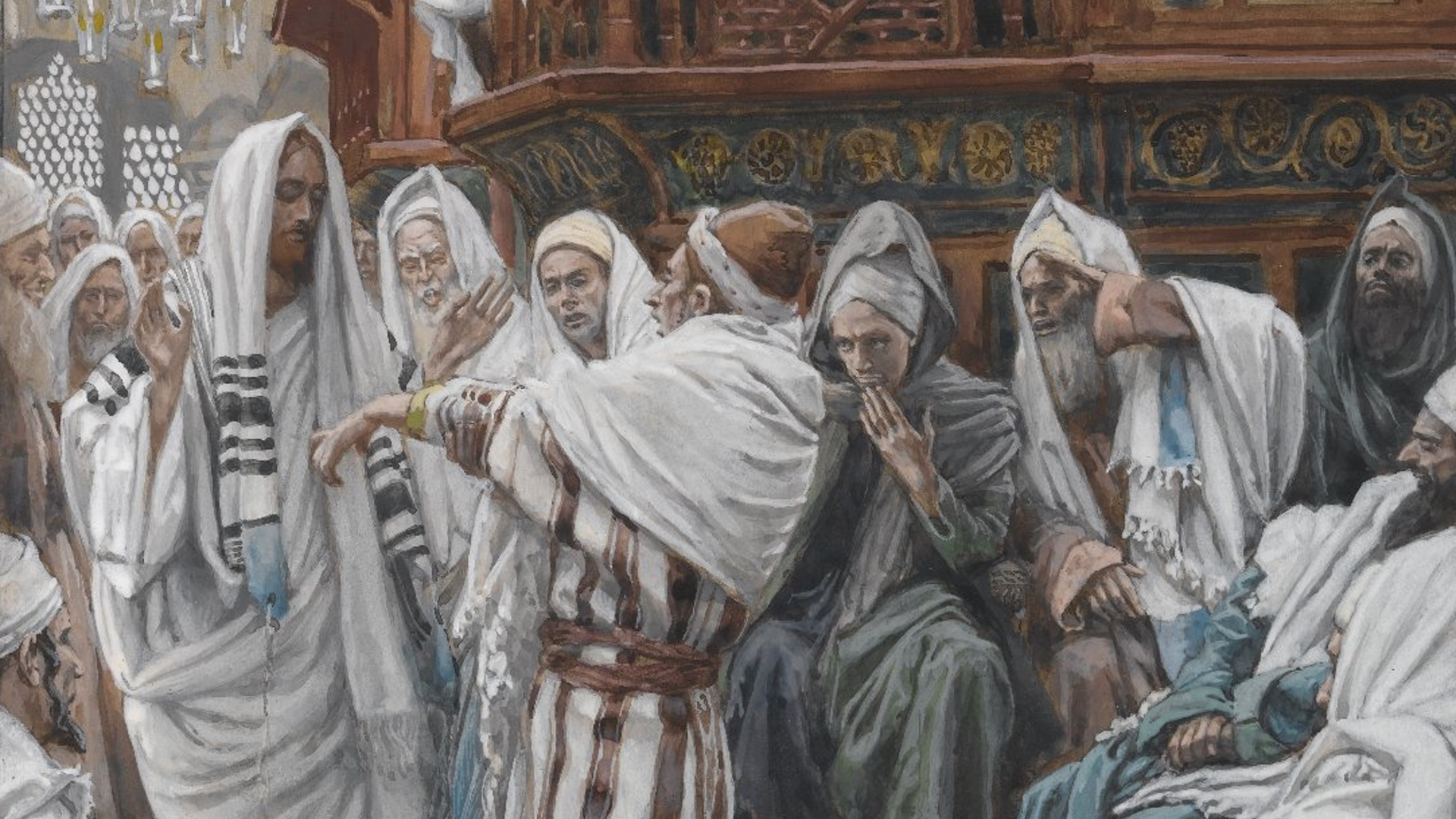
But He knew their thoughts, and said to the man who had the withered hand, “Arise and stand here.” And he arose and stood. Then Jesus said to them, “I will ask you one thing: Is it lawful on the Sabbath to do good or to do evil, to save life or to destroy?” And when He had looked around at them all, He said to the man, “Stretch out your hand.” And he did so, and his hand was restored as whole as the other. (Luke 6:8–10; NKJV)
Keeping the Sabbath holy was one of the central tenets of the Mosaic Law. It was the fourth commandment that God gave Israel at Mt. Sinai (Exod 20:8–11). The commandment explains that the seventh day of every week is to be a day of rest from work for everyone in Israel—all people, including children, servants, foreigners in Israel, and even work animals (v. 10).
The idea of Sabbath rest follows the pattern of Creation. Over six days God fashioned the heavens and earth and filled them, respectively, with the celestial bodies and all kinds of living creatures. He concluded with the creation of Adam and Eve, giving them instructions to rule over all other creatures and multiply in all the earth (Gen 1:26–2:3).
Critics and skeptics have argued that a God who needs rest isn’t much of a God. But the Scriptures never say God needed rest. They simply say that He did rest. It is biblically inaccurate to suppose that God needs rest. But if God did not need to rest, then why did He rest?
Jesus gives us a clear and concise summary of the Sabbath command in Mark’s account of the Sabbath controversies. As Mark 2:27 says, “The Sabbath was made for man, and not man for the Sabbath.” Note that Jesus’ teaching here is not new; rather, it speaks to the heart of the commandment as the Old Testament explains elsewhere (Exodus 23:12; Ezek 20:12).
God created humankind with inherent finitude and weakness. Although He commanded us to have dominion in all the earth, the fact of that command coming from God means that our dominion is limited and owes allegiance to God (Gen 1:28–30). God created us to live in relationship with Him, as both our physical life and our life purpose are ultimately found in Him.
God, being good and gracious, leads not only by command but also by example. Although God has no need for rest, He modeled the idea of rest in His pattern of Creation before sovereignly instructing us to maintain a pattern of intentional work and rest in our lives. Under the Mosaic Law, this instruction took the specific form of a strict seventh-day observance.
The New Testament teaches that Jesus fulfilled the Law on our behalf. Importantly, Jesus did not come to abolish the Law—He has brought it to a sense of completion (Matt 5:27; Rom 10:4). Since Jesus has fulfilled the Law, and the New Testament nowhere instructs Christians to observe the seventh-day Sabbath regulations in the Mosaic Law, Christ has freed us from those strict observances (Acts 15:22–29; Rom 14:5–6).
The New Testament teaches that the Christian finds spiritual rest in Christ (Heb 4). Although we are free from the strict observance required by the Mosaic Law, the idea of rest follows the example God gave us and remains an eternal truth. It shows us how God made us—neither primarily for work nor leisure, but for living in ongoing relationship with God and ordering our lives around an intentional pattern of work and rest.
One of the many ways the Enemy leads us away from God is through distraction. Many Christians struggle to find time to pray, read Scripture, and fellowship with other believers. There are so many things typical of life in the modern West that keep us busy—such as careers, education, family and/or friends, pets, and keeping a household running—that sleep is hard enough to come by. Finding the time to rest in the presence of God is nearly impossible.
In Luke 6:5, Jesus says, “the Son of Man is Lord of the Sabbath.” In saying this, Jesus is again identifying Himself as the Jewish Messiah.1 On one Sabbath, Jesus defended His disciples’ actions by appealing to an example of King David, identifying Himself as the promised Messianic King (Luke 6:3–5). On another Sabbath, He exposed legalism by healing a man, reaffirming His identity as Isaiah’s Anointed of God (Luke 6:9–10; Isa 61).
Jesus is our merciful, loving Messiah and Lord of our spiritual rest. We are not bound to the Sabbath regulations of the Mosaic Law. But we are reminded by the Sabbath that we need to regularly turn ourselves entirely—heart, mind, soul, and strength—toward our loving Lord to find our rest in Him (Mark 12:30; Matt 11:28).
Christian, are you tired? Are you suffering? Are you sick? Remember Jesus, our Lord of rest, and turn your attention and affection toward Him. Are you driven? Highly productive? Successful by modern worldly metrics? Remember Jesus, our Lord of rest, and turn your attention and affection toward Him. In all things, let all that you are be directed toward Jesus, and receive the rest that can be found only in Him.
Notes
- John T. Carroll, Luke: A Commentary (Louisville, KY: Westminster John Knox, 2012), 139. Logos Bible Software.
Discover more from Tim Northup
Subscribe to get the latest posts sent to your email.
 Tim Northup