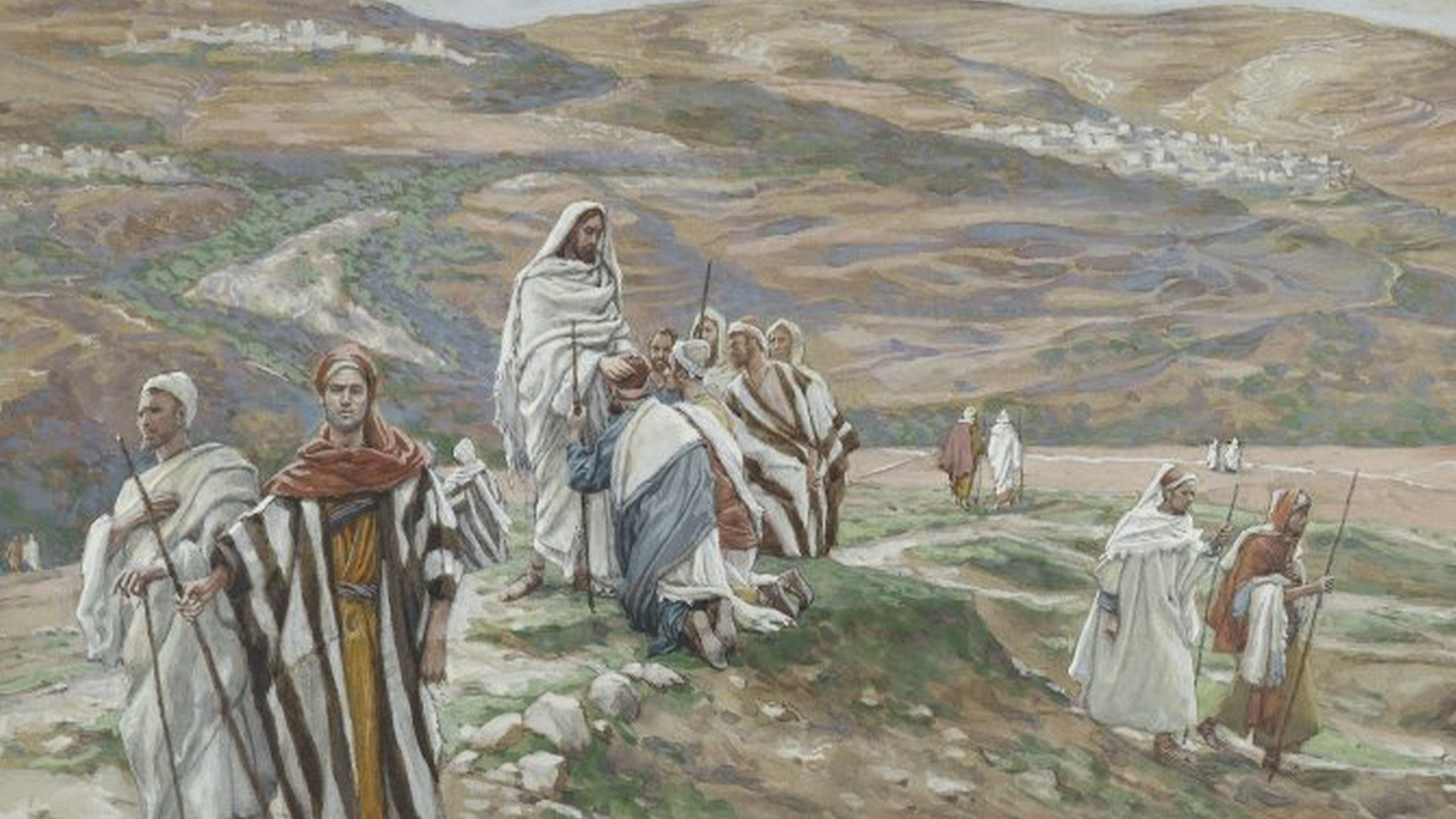
Then the seventy returned with joy, saying, “Lord, even the demons are subject to us in Your name.” And He said to them, “I saw Satan fall like lightning from heaven. Behold, I give you the authority to trample on serpents and scorpions, and over all the power of the enemy, and nothing shall by any means hurt you. Nevertheless do not rejoice in this, that the spirits are subject to you, but rather rejoice because your names are written in heaven.” (Luke 10:17–22; NKJV)
As Jesus journeyed toward Jerusalem, He sent messengers throughout Israel to prepare the cities that he would pass through to receive Him (Luke 9:51–52). For these cities, this would be their last opportunity to hear the Good News of salvation from Jesus Himself before His crucifixion and death.
Along the way, one of the Samaritan villages rejected Jesus. James and John, remembering God’s dealing with Israel during the time of Elijah the prophet, and no doubt emboldened by the authority Jesus had recently given them over spiritual things (Luke 9:1–6), asked Jesus if He wanted them to call down fire from heaven as judgment on the village. But Jesus rebuked them, explaining that the mission of His first coming was not one of judgment, but salvation (v. 56).
In Luke’s account of Jesus’ journey to Calvary, Luke places a strong emphasis on Jesus’ offer of salvation and Israel’s rejection of Him. This begins with the Samaritan village, followed by a combination of Jesus’ teachings on true discipleship contrasted with several encounters of Jesus’ rejection by many of His own countrymen.
Jesus was determined to share the Good News of salvation as widely as possible. Luke records that Jesus sent out another seventy (or seventy-two)1 of His followers to share the Good News in “every city and place where He Himself was about to go” (Luke 10:1). At the same time, Jesus told them to pray for even more like themselves to share the Good News.
When these returned, they reported back to Jesus with a sense of amazement that the demons were subject to them, too, in Jesus’ name (v. 17). Jesus replied that this was the very power He had given them (v. 19). Indeed, their message of the Good News of salvation would not be hindered, because He divinely empowered and protected them for their task.
But, Jesus continued, their power over the forces of darkness was not to be their focus. He instructed them rather to “rejoice because your names are written in heaven” (v. 20). The miracles were not an end in themselves; they were God’s divinely appointed evidence to attract the crowds and to affirm Jesus’ Good News of salvation through faith in the Son of God (11:20).
The idea that the names of every Christian are written in heaven is not foreign to Scripture. It is most common in Revelation, which says of the saints that our names are written in the Lamb’s Book of Life (13:8; 17:8; 20:15; Rev 21:27). But it is also found elsewhere in Scripture, such as Exodus (Exod 32:33), Daniel (Dan 7:10) and Paul’s letter to the Philippians (Phil 4:3).
When a child is born in the United States, that child is given a name and issued a birth certificate. This certificate identifies where the child was born and serves as proof of citizenship in the United States.2 Similarly, when a child is enrolled in a course at a school, the course has a roster where the student’s name is recorded, serving as proof of their enrollment in that course.
When Jesus tells the seventy to rejoice that their names are written in heaven, He is telling them to rejoice because they are counted as belonging with Him. Their citizenship is with Christ in the eternal Kingdom of God. God has a record with the names of everyone who belongs to Jesus, a record that guarantees our eternal life with our Lord.
The Apostle Paul expounds on the idea of our heavenly citizenship in Philippians 3:17–21,
Brethren, join in following my example, and note those who so walk, as you have us for a pattern. For many walk, of whom I have told you often, and now tell you even weeping, that they are the enemies of the cross of Christ: whose end is destruction, whose god is their belly, and whose glory is in their shame—who set their mind on earthly things. For our citizenship is in heaven, from which we also eagerly wait for the Savior, the Lord Jesus Christ, who will transform our lowly body that it may be conformed to His glorious body, according to the working by which He is able even to subdue all things to Himself.
Christian, our joy is not in any authority Christ might have given us over the powers of darkness, for our victory in the daily spiritual battle depends on our prayerful, daily surrender to the Lord (e.g., Matt 27:14–21; c.f., Eph 6:10–20). Neither is our joy found in any earthly thing, for the things of this world are fleeting and will pass away (Phil 3:17–21; c.f., 1 John 2:16). Our true and lasting joy is found in Jesus Christ alone, the Lamb of God, Who has written our names in His Book of Life and given His life for ours, that we might live eternally with Him.
Notes
- For a summary about the reading “seventy” or “seventy-two,” see James R. Edwards, The Gospel According to Luke, Pillar New Testament Commentary (Grand Rapids, MI: Eerdmans, 2015), 303–304. Logos Bible Software.
- “Citizenship Evidence,” U.S. Department of State Bureau of Consular Affairs, September 13, 2024, https://travel.state.gov/content/travel/en/passports/how-apply/citizenship-evidence.html.
Discover more from Tim Northup
Subscribe to get the latest posts sent to your email.
 Tim Northup
_-_James_Tissot_-_overall.jpg)