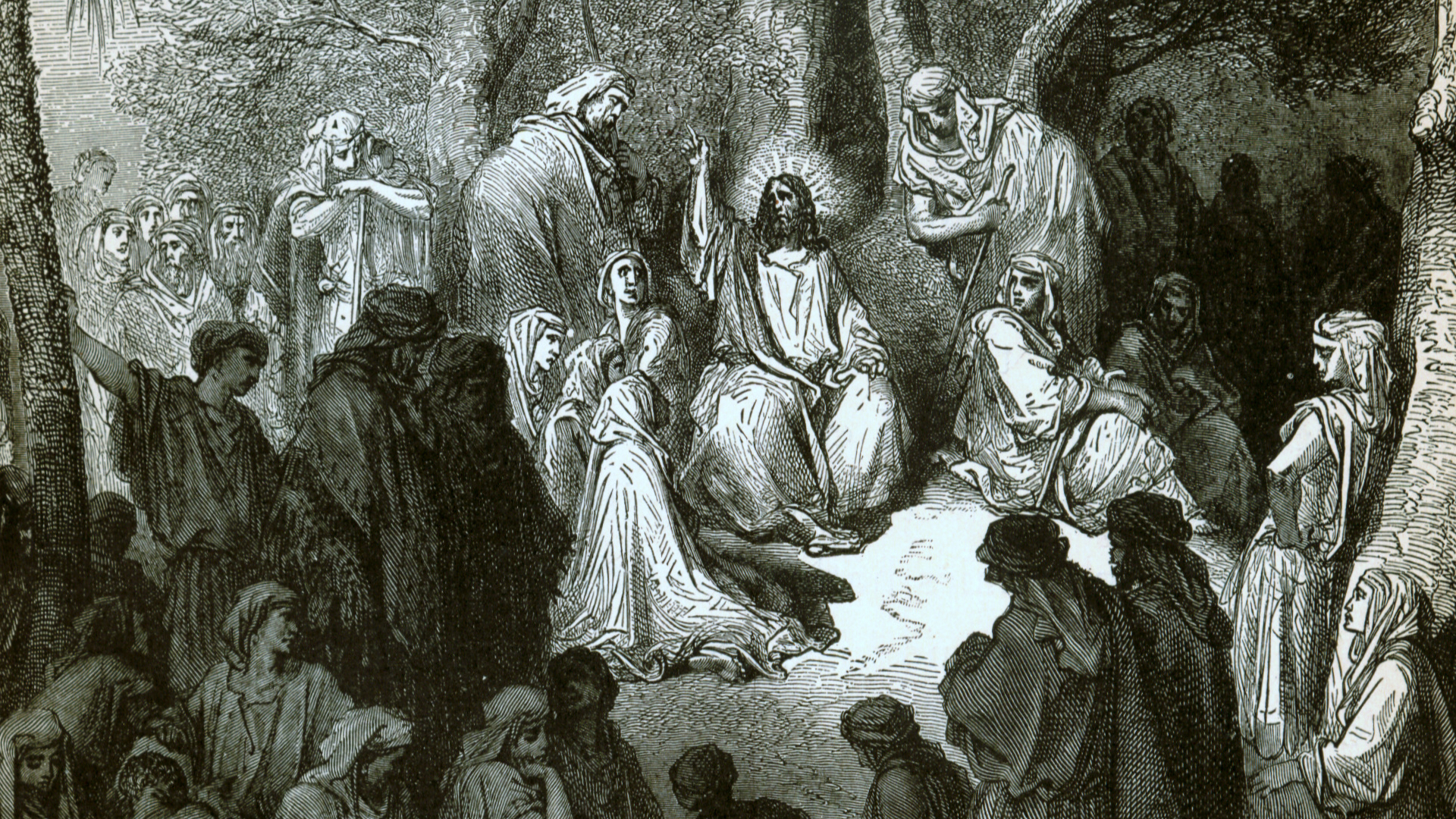
So I say to you, ask, and it will be given to you; seek, and you will find; knock, and it will be opened to you. For everyone who asks receives, and he who seeks finds, and to him who knocks it will be opened. If a son asks for bread from any father among you, will he give him a stone? Or if he asks for a fish, will he give him a serpent instead of a fish? Or if he asks for an egg, will he offer him a scorpion? If you then, being evil, know how to give good gifts to your children, how much more will your heavenly Father give the Holy Spirit to those who ask Him!” (Luke 11:9–13; NKJV)
As Jesus continued his journey to Calvary, he retreated in prayer. When He had finished, one of His disciples asked him to teach them to pray, just as John the Baptist had done for his disciples. Jesus made a habit of retreating from the crowds to pray (e.g., 6:12; 9:18, 28).1 He was a man of prayer, and His disciples desired to emulate His prayer life.
This was not the first time Jesus gave the model prayer. Jesus taught the same prayer during His Sermon on the Mount (Matt 6:9–13). Luke’s version is shortened, and Luke does not identify the disciple, suggesting that this disciple probably was not one of the Twelve and joined sometime later during Jesus’ ministry. Luke’s narrative, then, is describing a separate, later event where Jesus is summarizing His prior teaching.2
The flow of Luke’s narrative stresses the importance of prayer in our lives. Chapter 9 focuses on what it means to follow Christ—carrying our cross daily by denying self and committing our hearts to His purposes. Chapter 10 focuses on what following Christ looks like in daily life—learning the ways of our Lord, loving our neighbors, and sharing the Good News of salvation in Jesus—closing with Jesus praising Mary for her devotion to learning from and following Him.
Chapter 11 draws us in for a closer look at the way of Jesus, beginning with prayer. As mentioned, Jesus was a man of payer. Those who follow Jesus, then, must also be people of prayer. This raises many questions, as Luke’s narrative anticipates with the unnamed disciple’s request, “Lord, teach us to pray” (Luke 11:1).
First, notice that Jesus says “when you pray,” not “if you pray.” Although we must not press the point too far, there is an implied assumption that prayer is something a follower of Jesus does. The question is not if we pray, but when. Jesus answers that we should be persistent in prayer, as He illustrates with the Parable of the Persistent Friend (vv. 5–8).
Second, notice that Jesus did not quote His prior teaching word-for-word. Jesus is not teaching us to follow a strict formula, but a general pattern. Without diminishing the importance of the ideas in Jesus’ model prayer, Luke’s narrative stresses the importance of cultivating a pattern of prayer as a rhythm for life. Why? Because prayer is our earthly means of receiving all that the Father has for us, as as the Parable of the Good Father illustrates (vv. 11–13).
Jesus’ teaching between these two parables drives the point home. Jesus teaches us to keep asking, seeking, and knocking. True followers of Jesus embrace a regular rhythm of surrendering our cares to our Lord through prayer. Why? Because prayer is also God’s sovereignly prescribed method for confessing our sin, making our needs known, and casting our cares to Him.
We must not misunderstand this point. God is not a genie who grants our every desire, if only we will ask. Neither is He a malevolent being who demands rituals to appease His vengeance and earn His favor. And He is also not an absent sovereign who remains aloof from our feeble, finite, fragile existence.
God is a good and loving Father whose sovereign will is for us to live in holy fellowship with Him. The problem is, our sinfulness separates us from our holy God (Rom 3:23; Hab 1:13; 1 John 3:8). We need a Savior, which the Father has graciously provided in His Son, Jesus Christ, Who through His once-for-all death on the Cross payed the penalty for our sin so we, through faith in Him, may be reunited with the the Father through the Holy Spirit (Heb 10:19–22; 2 Cor 3:16–18; Rom 8:12–17).
God is a loving Father. And, by faith in Jesus Christ the Son and the indwelling presence of the Holy Spirit, He invites us to regularly withdraw from the world to seek refuge, rest, and renewal in Him through prayer.
How is your prayer life? Are you regularly withdrawing from the world to the loving presence of our Father in Heaven? Are you making a habit of expressing your deepest needs to Him and receiving all that He has for you through prayer? Let this be a gentle encouragement and reminder that stirs your heart to follow the example of our Lord by cultivating a rhythm of prayer in your life.
Notes
- Richard C. H. Lenski, The Interpretation of St. Luke’s Gospel (Minneapolis, MN: Augsburg Publishing House, 1961), 620. Logos Bible Software.
- Ibid.
Discover more from Tim Northup
Subscribe to get the latest posts sent to your email.
 Tim Northup
