Then He said to the disciples, “The days will come when you will desire to see one of the days of the Son of Man, and you will not see it. And they will say to you, ‘Look here!’ or ‘Look there!’ Do not go after them or follow them. For as the lightning that flashes out of one part under heaven shines to the other part under heaven, so also the Son of Man will be in His day. (Luke 17:22–24; NKJV)
As Jesus continued toward Jerusalem, He traveled through Samaria and Galilee (Luke 17:11). This would be his last pass through these regions on His way to the Cross. The warnings about giving offense (vv. 1–4) and about faithful service (vv. 5–10) bring the major section about true service in the Kingdom of God, beginning in Luke 15, to a close. Luke’s narrative now focuses on the coming of God’s Kingdom and the Son of Man.
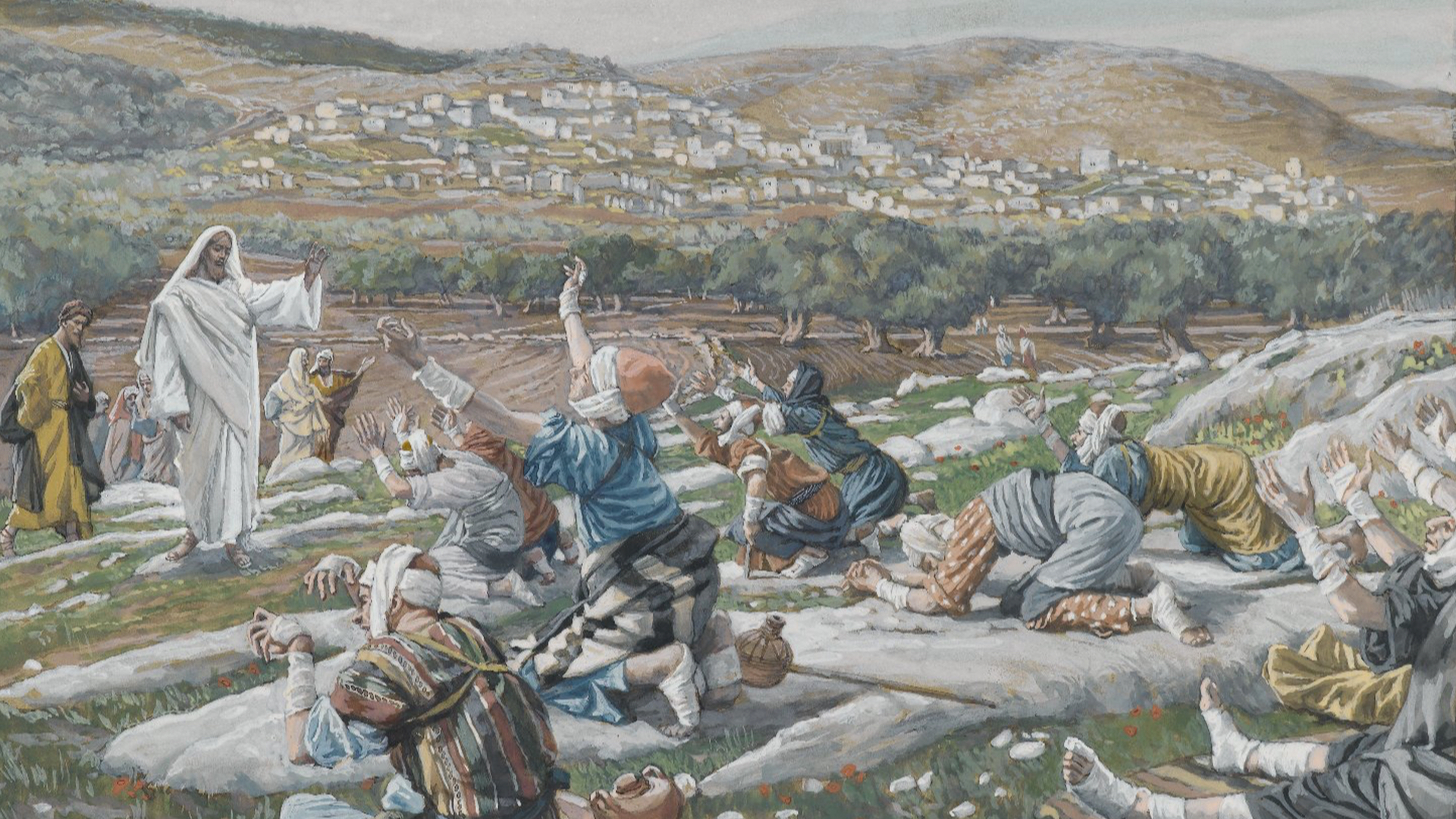
It is no accident that chapter 17 begins with the miraculous healing of ten lepers, only one of which returns to give thanks to Jesus. Jesus’ question, “Were not any found who returned to give glory to God except this foreigner?” (17:18) foreshadows the invitation of all nations to enter the Kingdom through a persistent, childlike faith in Jesus (18:1–8, 15–17).
It has always been the plan of God that the promise of His Kingdom, coming through and to the Jewish people, would extend to “all the families of the earth” (Gen 12:3; c.f., Exod 19:6; Rom 3:1–2). God has neither forsaken nor replaced Israel; rather, through her, He has brought forth the Son, the promised Seed, in whom He invites all peoples to receive salvation and the inheritance of the Kingdom by believing in Him (Num 24:17; Isa 2:2–4; Gal 3:16).
A short time after cleansing the lepers, some of the Pharisees asked Jesus about the coming of the Kingdom, something the disciples would also have questions about not much later (Luke 21; Acts 1:6–8). In recent theological debates, there is great focus on Luke 17:20–21. However, Jesus’ explanation is significant—Jesus links the coming of the Kingdom with the coming of the Son of Man (vv. 22–37).
The idea that Jesus has already returned has grown in popularity in recent decades. This view, called full-preterism, consistent-preterism, or hyper-preterism, holds that all of the prophesies of the Bible have been fulfilled, including the return of Christ. As Kenneth Gentry Jr. observes, “At the most basic level, hyper-preterists believe that AD 70 witnesses the final accomplishment of all prophecies not fulfilled before that time.”1
Interestingly, Jesus answers the Pharisees, “the days will come when you will desire to see the days of the Son of Man, and you will not see it” (v. 22). He continues, “first [the Son of Man] must suffer many things and be rejected by this generation” (v. 25). The teaching is clear: the fullness of the Kingdom would come with the Son of Man “in His day” (v. 24), neither of which would be experienced during that generation.
Here, then, we find boundaries for right thinking about the coming of the fullness of the Kingdom of God—it did not happen within the lifetimes of Jesus’ contemporaries; it will happen in close proximity with Christ’s return. We must therefore reject two extremes: one, that all prophesy in Scripture was fulfilled in 70 AD (full-preterism). And the other extreme: the complete dissociation of the coming of the Kingdom with the return of Christ.
Steeping away from the theological debates, how does the future promise of the fullness of the Kingdom impact how we live today?
First, we set our hearts on the future, eternal promises of God. Our union with Christ through the Holy Spirit grants us membership in the Kingdom of God (John 3:3–16). Thus, we look forward to the glorious promises of life with our Lord in God’s eternal Kingdom.
Second, we set our minds on the present promise of salvation for all who believe in Jesus. Though in this life we endure suffering, we endure it patiently, trusting our Lord to one day bring it to an end and bring us into His rest (2 Thess 1:4–6).
Third, we orient our lives around Kingdom service. Jesus preached “the gospel of the kingdom of God” (Mark 1:14). Paul understood his mission to the nations as work for the Kingdom (Col 4:11). Thus, our disciple-making mission to the nations (Matt 28:18–20) constitutes service to the Kingdom of God.
It is easy to get wrapped up in the finer details of theology. I do not intend to devalue the important work of those whom God calls to specialized theological training. The work of theologians is a great gift to the people of God!
However, I do want to encourage all of us to hold our relationships with our Lord and one another more tightly than our commitments to the tertiary matters of theology. Because it is not the tertiary matters that join us to the Lord. It is His love for us, drawing us to faith and repentance, that binds us in love to Him (1 John 3:16).
May we cherish the words of our Lord, including the wonderful promises of His return and the coming fullness of His Kingdom! And in our reflection and study, may we find ourselves drawn ever closer in faith and fellowship toward Jesus and one another in Him.
Notes
- Kenneth Gentry, Jr., He Shall Have Dominion: A Postmillennial Eschatology, 3rd Ed Rev. and Expanded (Chesnee, SC: Victorious Hope, 2009), 526.
Discover more from Tim Northup
Subscribe to get the latest posts sent to your email.
 Tim Northup