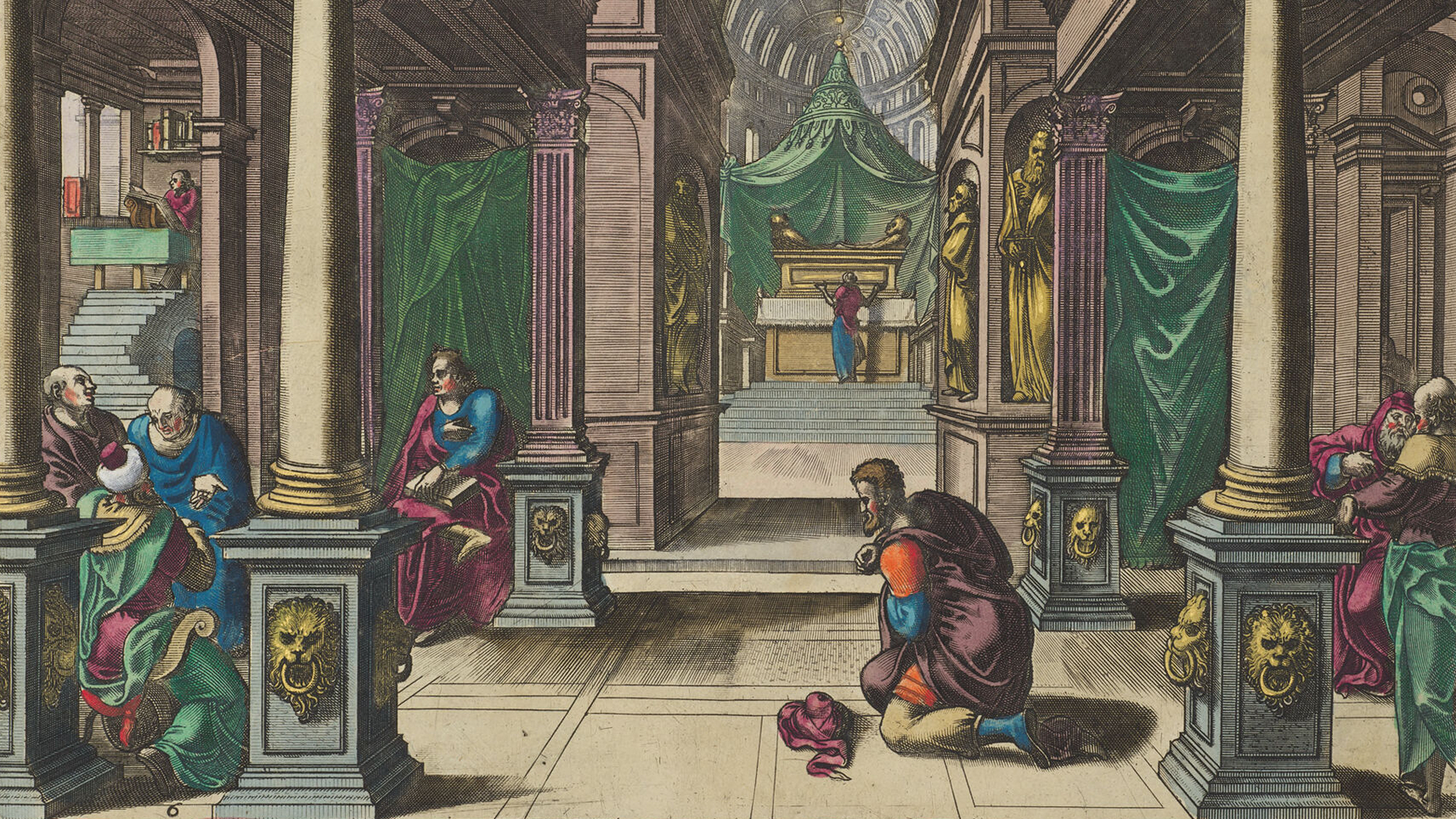
The tax collector, standing afar off, would not so much as raise his eyes to heaven, but beat his breast, saying, ‘God, be merciful to me a sinner!’ I tell you, this man went down to his house justified rather than the other; for everyone who exalts himself will be humbled, and he who humbles himself will be exalted.” (Luke 18:13–14, NKJV)
As Jesus traveled toward Jerusalem, many people gathered around Him, asking Him questions and listening to His teaching. Chapter 18 narrates some of Jesus’ encounters as He journeyed toward the Cross. The chapter opens with two parables about the kind of persistent, humble faith that God desires of us. These parables are followed by Jesus’ encounter with the little children, whose persistent, humble faith He instructs us to emulate.
After this, two encounters center around the question of a wealthy young ruler. Seeking to justify himself, he asks Jesus, “Good Teacher, what shall I do to inherit eternal life?” Note that Jesus did not reject the title Good Teacher—He received it while pointing out its full implications. This is an implied claim to deity. Jesus then reveals that eternal life is not earned, but received through the kind of faith that is wholly devoted to Him (c.f., Luke 14:33).
What a costly claim! Indeed, the price is too high to be humanly attainable. In our brokenness, we cannot even know our own hearts (Jer 17:9); it is impossible, then, that we find it in ourselves to relinquish in our hearts the ideas of our deepest, most cherished treasures. But what is impossible for us, God works within us such that whosoever lays down their idols and responds positively to the call of faith receives eternity with Him.
Jesus then takes the Twelve aside and tells them He will be crucified and raised on the third day. At this moment, they still do not understand these promises. But after they come to pass, the Disciples see how these promises confirm that Jesus is the promised Messiah of God. The stress in this chapter is how the promises of Jesus’ crucifixion and resurrection are God’s doing the impossible for us—saving us from sin and death to eternal life with Him.
The chapter closes with yet another miracle. As Jesus passes through Jericho, a blind man hears the news and cries out to Him, “Jesus, Son of David, have mercy on me!” (v. 38). This is a very interesting encounter to me for several reasons, three of which I will briefly mention.
First, there are questions about Luke’s order of events. Matthew, Mark, and Luke all retell this miracle or one like it near Jericho. Is this Bartimaeus son of Timaeus (Mark 10:46)? Is there only one blind man or are there two (Matt 20:30)? Does the healing occur before, during, or after Jesus passes through Jericho (Matt 20:29; Mark 10:46; c.f., Luke 18:35; 19:1)?
There are many reasonable ways to put the details together. My view is that Jesus passed through Jericho, found Zacchaeus, stayed the night, then left in the morning for Bethany. There are two blind men, Bartimaeus being the more vocal of the two and the focus of Mark and Luke. Jesus, either on His way to Zacchaeus’ house or when leaving in the morning, healed the men.
Second, notice how the man refers to Jesus. He calls Him “Son of David.” This is a title for the Jewish Messiah that comes from the Old Testament. It goes back to God’s promise to David in 2 Samuel 7:14–16. God promised to establish David’s house, kingdom, and throne forever. This promise was unconditional and eternal.1 And it revealed that the Jewish Messiah would reign as God’s Anointed King in the eternal Kingdom of God (e.g., Ps 2; 110).
Luke is once again showing Jesus to be the fulfillment of the promised Messiah of God. His healing of this blind man fulfills His Luke 4:18 mission, which is itself the fulfillment of the Isaiah 61:1–2a mission of the Redeemer of Zion. Luke is connecting the dots, exalting Christ as the Son of Man who will one day return in power and glory (Luke 21:27; c.f., Matt 25:31–32).
Third, the blind man’s cry echoes the tax collector’s prayer at the beginning of the chapter, “God, be merciful to me, a sinner!” (v. 18:13). The blind man, a social outcast, presumed to be guilty of sin or born into it (c.f., John 9:1–2), risked public humiliation to come to the only One who holds the power restore both His body and any sense of social dignity.
The crowds shushed the man’s desperate cries (v. 39). But is his public humiliation, powerless to come to Jesus, the man, full of faith in Jesus, persisted. And of all those Jesus encountered during this pass through Jericho, only three made the biblical records—Zacchaeus, and the two blind men. Both encounters exemplify the kind of humble, persistent, child-like faith that God desires from us.
As we draw nearer to Christmas, don’t let the celebrations distract from the reason for the season. Jesus Christ, the Son of God, was born a humble babe. He put on flesh and came as a man—living, dying, and rising again—to save us from sin and death, that we might receive eternal life through faith in Him.
May our Savior and Lord renew our hearts by filling us with a humble, persistent, child-like faith in Him this Christmas season.
Notes
- J. Dwight Pentecost, Things to Come: A Study in Biblical Eschatology (Grand Rapids, MI: Zondervan, 1958), 100–115. Logos Bible Software.
Discover more from Tim Northup
Subscribe to get the latest posts sent to your email.
 Tim Northup