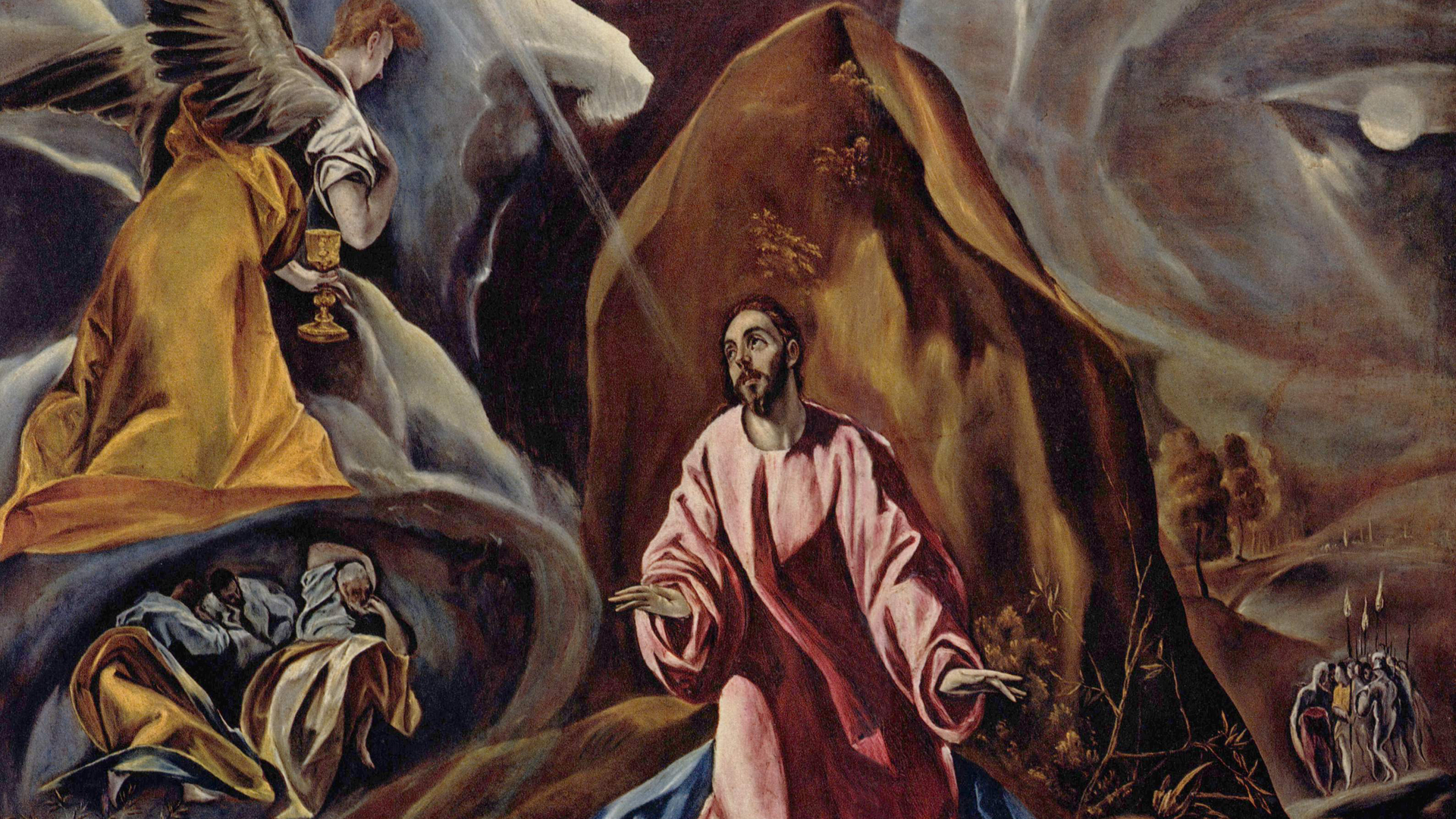
And He was withdrawn from them about a stone’s throw, and He knelt down and prayed, saying, “Father, if it is Your will, take this cup away from Me; nevertheless not My will, but Yours, be done.” Then an angel appeared to Him from heaven, strengthening Him. (Luke 22:41–43; NKJV)
Jesus’ Passover observance with the Twelve was the last time He and the Twelve were altogether. Toward the end of the meal, Jesus released Judas to carry out the plans he had already committed his heart to do (John 13:18–30). A few hours later, in the Garden of Gethsemane on the Mount of Olives (Mark 14:32; Luke 22:39), Judas arrived with “a multitude” to arrest Jesus, betraying Him “with a kiss” (Luke 22:47–48).
Luke records that after Judas left the meal, Jesus and the Eleven “went to the Mount of Olives, as He was accustomed” (Luke 22:39). This was not Jesus’ first time coming to this location. Since arriving in Jerusalem for Passover, the Mount of Olives was his regular evening retreat with the Twelve. Judas would know exactly where to find Him (Luke 21:37).1
Twice Jesus told the disciples, “pray, lest you enter into temptation” (Luke 22:40, 46). After the first time, Jesus led by example, withdrawing from them a short distance to pray. John 17 gives us a summary of Jesus’ prayer. He prayed for Himself, the Eleven, and all believers. And now, regarding Jesus’ earthly ministry, his task was finished (John 17:4). All that remained was the suffering and death He would soon endure on our behalf.
When we read repeated phrases in Scripture, it is neither accident nor coincidence. This chapter of Luke depicts several instances of temptation, culminating with Peter’s denial of Jesus. The first temptation, already in sinful motion, is Judas’ betrayal of Jesus. The second is Jesus’ wrestling with the fate He is about to endure. The third is the disciples’ temptation to fight the arresting mob. The fourth is Peter’s denial of Jesus.
Among these temptations, we see decisive victory only once: Jesus. We see complete defeat twice: Judas and Peter. And we see defeat restrained by Jesus when He steps into the fray of the arrest, healing the ear of Malchus, the servant of the high priest, which Peter had severed (Luke 22:50; c.f., John 18:10).
What can we glean from these temptations? First, we see that Jesus, being tempted, remained faithful (Heb 4:15). As His flesh was failing, He sought refuge and strength from the Father. God provided the strength He needed, in this instance through an angel (Luke 22:42–43).
Second, we see that living alongside Jesus and His people is not sufficient to bring us salvation and include us as His own. Judas lived and ministered with Jesus for three years. Yet, three years in, he was still a “thief” (John 12:6). Despite living and ministering with Jesus, Judas had not received the transforming power of Christ in his life.
But it is not ultimately Judas’ thievery or betrayal for which he is counted “lost” (John 17:12). Peter’s denial and restoration show that even denying Jesus is not beyond the restoring power of God (John 22). It was Judas’ reception of Satan and lack of repentance that was the reason for his eternal separation from God (Luke 22:3).
Third, we see that even the bravest and boldest of believers is not beyond temptation to the point of sin. Remaining steadfast through temptation requires a God-empowered resolve that comes through seasons of trial (Jas 1:2–4). So, as Christ extended grace and mercy to Peter, we, too, must extend grace and mercy toward those suffering through temptations and trials.
Temptation is a normal human experience. It grows from the seed of sin within each of us, enticing us with promises of happiness and blessing apart from God (Jas 1:14). Only Jesus has resisted temptation to the point of shedding blood and without falling into sin (Heb 12:3–4). Our inherited sinfulness is why we pray God to keep us from temptation and deliver us from evil, trusting Him to give us strength us to flee to Him for refuge (Matt 6:13; 1 Cor 10:13).
Reader—if you think you do not sin, beware! Ask the Lord to reveal those areas of your heart that stand against Him, then repent and run to Him (1 John 1:18–2:2).
And when your sin weighs heavy on your heart, remember our Lord’s suffering and death on our behalf. He died the death that we deserve so we might trust in Him and receive eternal life. Just as Jesus did not abandon Peter, He has not abandoned us. He invites you, even now—come. Bring your brokenness and sin to Jesus and let Him make you whole again.
Notes
- James R. Edwards, The Gospel according to Luke, The Pillar New Testament Commentary, ed. D. A. Carson (Grand Rapids, MI: Eerdmans, 2015), 644. Logos Bible Software.
Discover more from Tim Northup
Subscribe to get the latest posts sent to your email.
 Tim Northup
