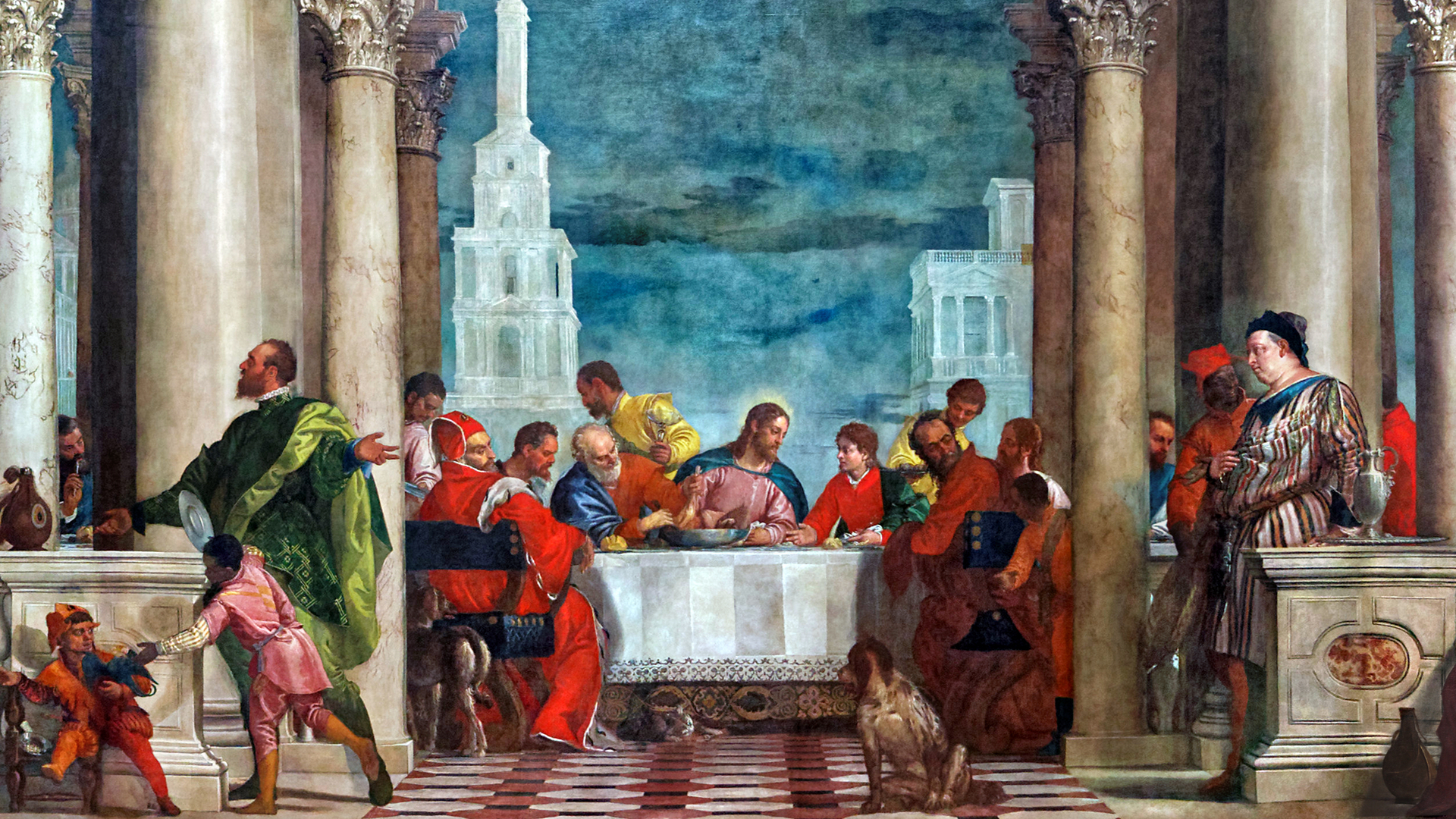
And their scribes and the Pharisees complained against His disciples, saying, “Why do You eat and drink with tax collectors and sinners?” Jesus answered and said to them, “Those who are well have no need of a physician, but those who are sick. I have not come to call the righteous, but sinners, to repentance.” (Luke 5:30–32; NKJV)
One of the curious topics in modern Christianity is the intersection of personal holiness and public witness. Christians are often criticized for being legalistic and prudish when we abstain from certain festivities and observances in Western culture. On the other hand, when Christians do participate in such activities, we are often criticized for adopting pagan culture.
The tension between the two extremes of forsaking worldliness and enjoying Christian liberty has existed since the birth of the church. It is a major topic in passages such as Romans 14 and 1 Corinthians 8–10. And it is something that has continued to be an area of division among Christians throughout various Christian communities during the Middle Ages and into the Modern era.
Christians experience a very real tension here for at least three reasons. First, many enjoyments in this life have a poor track record of making people slaves to our appetites—food, greed, power, sex, status, wealth, etc.—causing great harm to ourselves and others.
Second, any kind of activity or enjoyment that ensnares us becomes the guiding focus of our lives, blinding us to spiritual things and driving a wedge between us and God, others, and Creation.
Third, Christ calls us to freedom from sin and shame, including things that the world has attempted to lay claim for itself, such as food sacrificed to idols and days that are held in high regard.
How does all this relate to Jesus’ response to the Pharisees? The heart of the issue is the intersection of righteousness and sin. For Christians, Christ came to free us from enslavement to sin (Luke 5:18; Rom 6). In the same way that a physician offers physical healing for those who are physically sick, Jesus came to bring spiritual healing for those suffering the spiritual sickness of sin, which leads to eternal death.
In the verses above, the word ‘righteous’ (dikaios) has the idea of measuring up to an ethical standard.1 In contrast, the word ‘sinner’ (hamartolos) refers to someone who has broken the law or social norm—i.e., one who fails to live up to an ethical standard.2
Also, the Pharisees were a large and influential sect within first century Judaism. They were known especially for their strict observance of their interpretation of Old Testament Law, including their social separate-ness within common society.3
In this scene at Levi’s house (Luke 5:29), the ‘righteous’ Pharisees were criticizing Jesus’ disciples because they were eating and drinking with “tax collectors and sinners” (v. 30). Throughout much of the ancient world, eating and drinking together was a show of association and fellowship.4
From the viewpoint of the Pharisees, Jesus—a significant religious teacher—and His disciples should have been distancing themselves from such “sinners,” not fellowshipping with them.
But Jesus did not come to cater to the ‘righteous’ in society. He came to actively pursue those who have a deep sense of their own spiritual need for the salvation that comes only from God.
There are two kinds of righteousness: the superficial external righteous measured by the norms of society, and the true inner righteousness measured by God’s standards. The Pharisees were known for the former, which Jesus exposed in Matthew 23:13–36. But Jesus came to give the latter, which we receive only through a denial of worldly righteousness and by trusting in Jesus Christ (2 Cor 5:21; 1 Cor 1:30).
All humans are guilty of sin. All humans are deserving of physical, spiritual, and eternal death. This is the plain teaching of Scripture (Prov 20:9; Ecc 7:20; Rom 3:23; 1 John 1:8). But God desires that none of us should die in our sin and suffer eternal death (2 Pet 3:9). So, He sent His one and only Son, Jesus Christ, to die the death that we deserve so we might believe in Jesus and receive eternal life with Him (John 3:16–17).
Praise be to God, who saw our sickness of sin unto eternal death, and sent His Son, the Great Physician to heal us! He took our sickness and pain upon Himself and carried them to the Cross; by His wounds we are healed (Isa 53). Christian, this is our God. This is who He is and what He does—He loves us, He heals us from sin, He saves us from eternal death, and He gives us everlasting life with Him.
Notes
- Christopher A. Beetham, ed., “δικαιοσύνη,” in Concise New International Dictionary of New Testament Theology and Exegesis (Grand Rapids, MI: Zondervan Academic, 2021), 226–227. Logos Bible Software.
- Christopher A. Beetham, ed., “ἁμαρτάνω,” in Concise New International Dictionary of New Testament Theology and Exegesis (Grand Rapids, MI: Zondervan Academic, 2021), 63. Logos Bible Software.
- Clayton Harrop and Charles W. Draper, “Jewish Parties in the New Testament,” in Holman Illustrated Bible Dictionary, ed. Chad Brand, Charles Draper, Archie England (Nashville, TN: Holman, 2003), 917. Logos Bible Software.
- John A. Martin. “Luke,” in The Bible Knowledge Commentary: An Exposition of the Scriptures: Old Testament, ed. John F. Walvoord and Roy B. Zuck (Wheaton, IL: Victor, 1985), 218. Logos Bible Software.
Discover more from Tim Northup
Subscribe to get the latest posts sent to your email.
 Tim Northup
.jpg)
Love the site. Viewed through Christian writers group on Facebook. Thanks for sharing
LikeLike