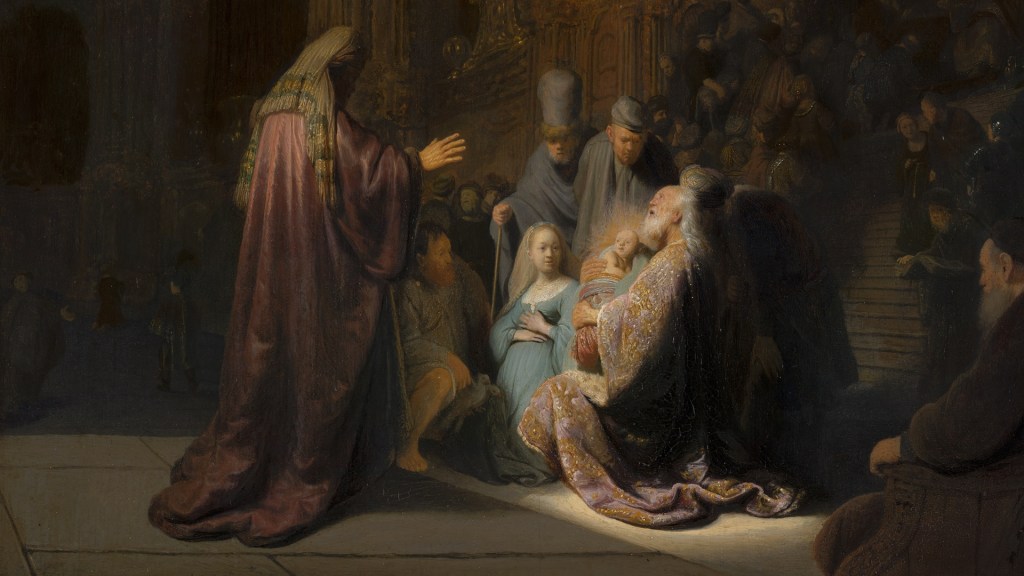
And behold, there was a man in Jerusalem whose name was Simeon, and this man was just and devout, waiting for the Consolation of Israel, and the Holy Spirit was upon him. And it had been revealed to him by the Holy Spirit that he would not see death before he had seen the Lord’s Christ. (Luke 2:25–26; NKJV)
Have you ever wondered about God’s plans for your life? Worried what the future might hold for your career? Struggled through a hard season of loss or personal health issues? Longed for some dream, but obstacles just keep piling up? Keep praying and trusting God in the waiting. As we see in the life of Simeon—God plans our days and will faithfully bring those plans about in our lives.
We know only a few details about Simeon. First, He was “just and devout,” which means he loved God in his heart and was faithfully committed to living for Him. Second, “the Holy Spirit was upon him,” had “revealed to him” that he would see the Messiah, and moved him to go to the Temple on that day at that time, showing that Simeon was sensitive and surrendered to the Holy Spirit’s leading in his life. Third, Simeon speaks Scripture over Jesus and prophesies to Mary, showing that Simeon knew the Scriptures and was not shy about following God’s leading in ministering to others.
The Consolation of Israel is an important Old Testament idea. God’s consoling (or comforting) Israel, through the coming of her Messiah, is especially prominent in the later parts of Isaiah (for example: Isa 40:1; 52:9; 61:2; 66:13).1 Looking especially at Isaiah 61:1–2, these verses are a combination of what Jesus reads in the temple (Luke 4:18) and the comfort God promised through the Messiah, whom Simeon was looking forward to seeing before his death.
Notice that it was the Holy Spirit who promised Simeon that he would see the Messiah and led him to the Temple on that day at that time. Although Simeon was morally upright and spiritually faithful, these were not the reasons for his seeing Jesus. The Holy Spirit led Simeon according to the promise God had already given him. We do not earn special privileges or rewards with God for living obediently. Instead, we receive the blessedness of spiritual closeness with Him and a supernatural sense of God’s presence and leading in our lives.
Notice also that Simeon says of salvation, “which You have prepared before the face of all peoples / a light to bring revelation to the Gentiles.” There are some sectors of Christianity teaching that God’s plans of salvation changed with the coming of Jesus to include the Gentiles, seeing the Gentiles, or some say the church, replacing Israel as the new people of God. But I do not think this teaching accurately reflects the Scriptures.
God’s plan of salvation did not change to include the Gentiles—it has always been to include Gentiles in salvation through the Messiah (see Isa 9:1–2; 42:6; 49:6; compare with Gen 12:3). The difference is in the amount of revelation God gave at different times in human history. God promised that His Messiah would come through Israel and would bless all the nations by bringing salvation to the whole world through Israel’s Messiah. The next phase of that plan was about to begin, for, as Simeon testified, the Messiah had come.2
In verse 29, Simeon says, “Lord, now You are letting Your servant depart in peace, / according to Your word.” We can only imagine what it must have been like for Simeon in that moment. He had been waiting on God’s promise in his life, maybe for quite some time. However, now that God’s promise to Simeon was fulfilled, it is very possible that God called Simeon home to Paradise only a short time later. Did Simeon even make it home? Did he get a final farewell with his family? Or did he live several more years after this moment?
We can speculate what happened to Simeon, drawing from Christian tradition, but the Scriptures simply do not say what happened to him. This underscores an important point—tomorrow is never promised. Especially in the West, many of us make plans several months to several years beforehand. But it is important to remember that God may call us into eternity before the present day is done. Those closest to you will remember you—not for your wealth or work, status or social activism—but for the loving care you shared with them during your life.
In this brief moment in the Temple, we see Simeon’s faith on full display, honoring God, praising Him for His faithfulness. We also see Simeon honoring Jesus, recognizing Him as the fulfillment of God’s promised Consolation of Israel. Simeon waited on God’s timing and trusted God to faithfully carry out His promises to Israel and in His own life.
What promises are you waiting on God to bring to fruition in your life? Are you waiting in faithful obedience, trusting God to fulfill them in His time, in His ways? Waiting on God can be difficult and discouraging. But do not lose heart. Keep waiting on, praying to, and trusting in the Lord. He has planned your days and He will faithfully bring those plans to pass according to His perfect manner, measure, and time (Prov 3:5–6;16:9; Phil 1:6).
Notes
- James R. Edwards, The Gospel According to Luke, Pillar New Testament Commentary (Grand Rapids, MI: Eerdmans, 2015), 84. Logos Bible Software.
- Ibid., 85.
Discover more from Tim Northup
Subscribe to get the latest posts sent to your email.
 Tim Northup
