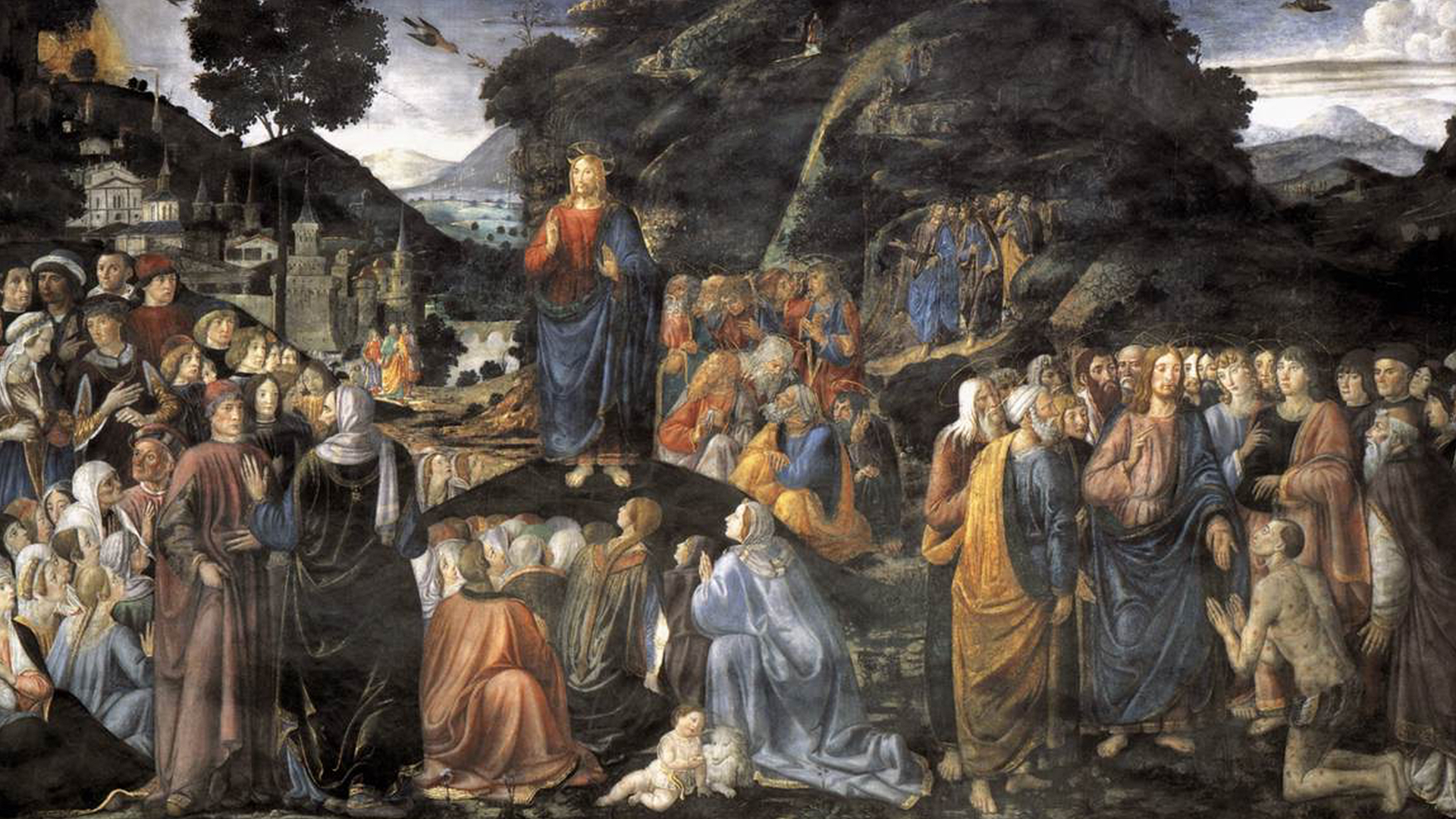
Whoever comes to Me, and hears My sayings and does them, I will show you whom he is like: He is like a man building a house, who dug deep and laid the foundation on the rock. And when the flood arose, the stream beat vehemently against that house, and could not shake it, for it was founded on the rock. (Luke 6:47–48; NKJV)
What idea is at the center of the Christian faith? What is that primary thought that distinguishes Christianity from all other worldviews? What single concept is so essential that, to take it away, would make someone’s worldview not Christian? The central truth of Christianity, which every other truth builds on, is not a “what,” but a “who”—the man, Jesus Christ.
If Jesus is who Christians claim He is, then God the Son has come and lived among us, died to provide atonement for our sins, risen to prove His identity and His victory over sin and death, and made the way for us to become reunited in relationship with the Father. Without the person and works of Jesus Christ, the Christian faith is nothing more than another Abrahamic religion.
Luke chapter 6 narrates Luke’s version of the Sermon on the Mount. In comparison with Matthew’s version, Luke’s is shorter and more focused. Where Matthew includes material specifically referencing Old Testament Law, such as murder, marriage, and prayer, Luke omits these, including some of that material later in chapters 11–12.
By doing this, Luke is keeping His focus on Jesus as Isaiah’s Anointed Suffering Servant. He connects Jesus’ teaching here with His initial sermon from Isaiah at the synagogue in Nazareth (Luke 4:16–30), where Jesus claims to have come with good news for the poor, healing for the brokenhearted, and freedom for the oppressed.
But Luke, like Matthew, begins Jesus’ Sermon on the Mount with the Beatitudes and ends it with the parable of the two builders. Together, these details focus Luke’s version of the Sermon on the authority and identity of Jesus. Was Jesus a miracle worker? Yes, but not only, nor primarily. Was Jesus a wise teacher? Yes, but not only, nor primarily. Jesus taught with authority, which implicitly required a heart response from every hearer—will you follow Him?
In the parable of the builders, Jesus compares the person who listens and obeys Him to the builder who built their house with a foundation on the rock. In the Midwest of the United States, every house requires a proper foundation if it is to survive the spring thunderstorms, which bring violent winds, large hail, and raging floods. The foundations that hold up throughout the years are those build with great attention to detail—just the right mixture of concrete for maximum strength, with proper grading and waterproofing for drainage, etc.
The true Christian listens and obeys Jesus—not just the polite, popular teachings of loving others, but also the finer details. This begins with believing in Jesus, but it doesn’t stop there. It means becoming a disciple, or apprentice, to Jesus by orienting life around His priorities—sharing the good news of the Kingdom of God, praying to the Father, pursuing personal holiness, and aiming to live in God-glorifying community with both believers and nonbelievers (Luke 9:18–27; 1 Pet 1:13–16; Rom 12:9–21).
In contrast, Jesus compares the person who listens but does not obey Jesus to the builder who built their house without a proper foundation. Such a house stands tall and true in nice weather. But when disastrous storms come, such a house does not survive. It is torn apart by violent winds, crushed by large hail and debris, and swept away by raging flood waters.
At times, Christianity has exerted strong influence in national and world affairs, sometimes organically through widespread conversion, but other times superficially through coercion. In all cases, since the end of Christian persecution in the Roman Empire in the 300s, wherever Christianity has exerted strong influence, cultural Christianity—a social value system that lacks true faith in Jesus—has become commonplace.1
Cultural Christianity is a house without a foundation. It lacks power—saving power. Sanctifying power. Power to bring about God’s priorities on earth and His purposes in our lives. Because it lacks true faith in Jesus. And we receive salvation, sanctification, and the Kingdom only by trusting in the man, Jesus Christ (John 3:3–16).
Jesus Christ is the rock of our salvation, the anchor four our souls (1 Pet 2:6–8; Heb 6:19). He is our lifeline, our tether to eternity, our hope for heaven (Col 3:1–4). He is the way, the truth, and the life—there is no other name under heaven by which we can be saved, but Christ alone (John 14:6; Acts 4:10–12).
Christian, remember the hope of your salvation and anchor for your soul. Let your heart and mind be captivated by Him again! Let the Holy Spirit bring His teaching to life within your soul, guiding your steps, orienting your days, deepening your union with Jesus, and strengthening your relationship with the Father through Him.
Notes
- A. Scott Moreau, Gary R. Corwin, and Gary B. McGee, Introducing World Missions: A Biblical, Historical, and Practical Survey, 2nd ed. (Grand Rapids, MI: Baker Academic, 2015), 93. Logos Bible Software.
Discover more from Tim Northup
Subscribe to get the latest posts sent to your email.
 Tim Northup
