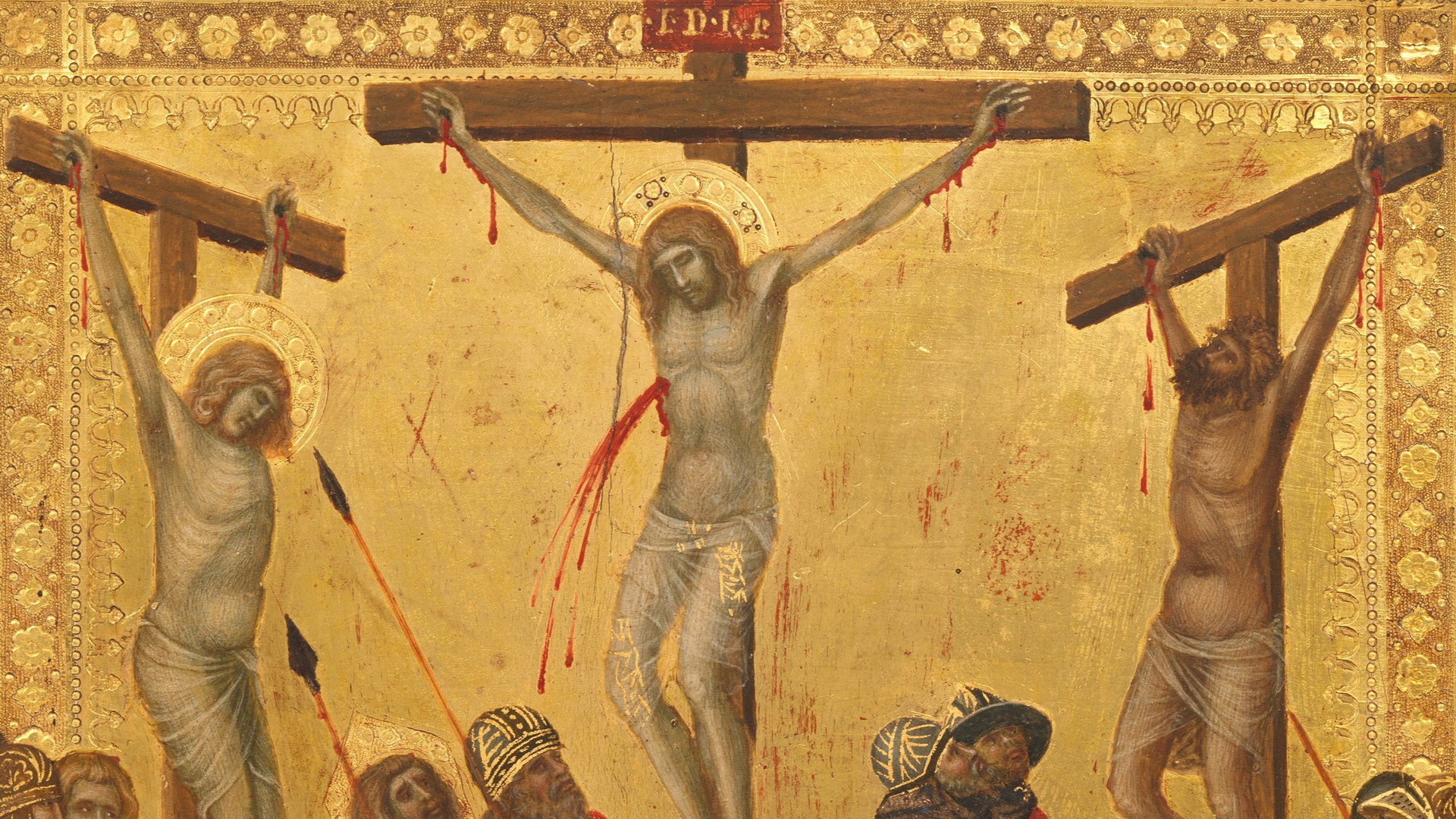
Now it was about the sixth hour, and there was darkness over all the earth until the ninth hour. Then the sun was darkened, and the veil of the temple was torn in two. And when Jesus had cried out with a loud voice, He said, “Father, ‘into Your hands I commit My spirit.’ ” Having said this, He breathed His last. (Luke 23:44–46, NKJV)
Friday morning, as the first light was appearing, the arresting mob took Jesus to the Jewish ruling council, the Sanhedrin (Luke 22:66–71). Jesus said little during this trial. But Jesus surely knew the power of the words He spoke. The Sanhedrin’s response, “What further testimony do we need? For we have heard it ourselves from His own mouth” (vv. 71), evidences the meaning of Jesus’ humble affirmation that He is “the Christ, the chosen of God” (Luke 23:35).
The events of Friday morning unfold in rapid succession. The first half of Luke 23 narrates Jesus’ trial by Pilate, then Herod, then Pilate’s public ruling that he “found no fault in this Man” (23:14). Pilate intended to release Jesus (v. 20), following a practice of releasing a prisoner during the Passover feast.1 Instead, the Jewish leaders instigated the crowd to chose an insurrectionist named Barabbas (v. 25). Whereas the people had previously buffered Jesus from His critics (22:2), they now sided against Him, demanding His crucifixion (vv. 18–23).2
Luke alludes to several prophetic fulfillments in this chapter. In my last post, I identified three prophetic details from Isaiah 53. Here, let’s look at three prophetic details from Psalm 22.
One prophetic detail in Psalm 22 echoed in Luke 23 is the ridicule that Jesus endured. Psalm 22:7–8 says,
All those who see Me ridicule Me;
They shoot out the lip, they shake the head, saying,
“He trusted in the Lord, let Him rescue Him;
Let Him deliver Him, since He delights in Him!”
Luke 23 echoes these lines in vv. 35–37. The people, leaders, and soldiers mocked Jesus while He was on the cross. Some said, “He saved others; let Him save Himself if He is the Christ, the chosen of God” (v. 35). But they confused ability with decision. Jesus could rescue Himself, but He chose to endure the cross because of His great love for us (Matt 26:53; 1 John 3:16).
A second prophetic detail in Psalm 22 is the division of Jesus’ clothing. Psalm 22:16–18 says,
For dogs have surrounded Me;
The congregation of the wicked has enclosed Me.
They pierced My hands and My feet;
I can count all My bones.
They look and stare at Me.
They divide My garments among them,
And for My clothing they cast lots.
While Jesus was on the cross, the people looked on. The crowd included Gentiles (especially the Roman soldiers), sometimes called “dogs” in ancient Jewish culture, referring to their ritual impurity under the Mosaic Law.3 And while Jesus was on the cross, some of the people cast lots for His clothing, dividing the garments among themselves (Luke 23:34).
A third prophetic detail in Psalm 22 is that Jesus’ followers would pass along their faith in Jesus. Psalm 22:30 says,
A posterity shall serve Him.
It will be recounted of the Lord to the next generation,
They will come and declare His righteousness to a people who will be born,
That He has done this.
Note that followers of Jesus were present at His crucifixion and performed His burial (Luke 23:49–55). And it was a small group of faithful women who found the empty tomb and were the first to share the news of Jesus’ resurrection (v. 24:9). The Good News of Jesus lived on through the testimony of His faithful followers as they shared their faith and experiences with others.
The Bible, from beginning to end, looks to the Chosen Son of God—His promised coming, His sacrificial dying, His victorious rising, and His triumphant returning. Jesus is that Chosen Son of God. He died the death that we deserve to redeem us from our sins that we might believe in Him and receive eternal life.
If you have not trusted in Jesus as your Savior and Lord, I invite you to do so today. And if you have, remember and rejoice, for your salvation has come! This Passion season, may we both grieve our Savior’s wounds and death, and also rejoice because our loving God has kept His promises—He has rescued us from the power of darkness and transferred us into the kingdom of the Son of His love (Col 1:13)!
Notes
- For discussion of the historicity of this practice, see John Nolland, Luke 18:35–24:53, Word Biblical Commentary 35C (Dallas: Word, 1993), 1130. Logos Bible Software.
- Ibid., 1128.
- In ancient Jewish culture, sometimes Gentiles were called “dogs,” an insult referring to their ritual uncleanness. See Chad Brand, et al., eds., “Dog,” in Holman Illustrated Bible Dictionary (Nashville, TN: Holman Bible Publishers, 2003), 438. Logos Bible Software.
Discover more from Tim Northup
Subscribe to get the latest posts sent to your email.
 Tim Northup